Parameter Editors Summary
The “Link Editor”, “ICI Editor”, and “PDF Editor” are used to specify one type of model. Collectively, these types of models are referred to as parameter models because they are mainly used as assignments for complex attributes (that is, parameters) of objects. There are three types of parameter models:
- Link model
- Interface Control Information (ICI) format
- Probability density function (PDF)
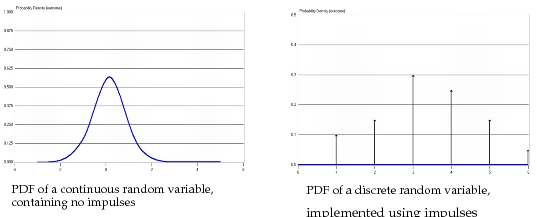
Most parameter models take the form of a functional relationship (in which case they are edited graphically) or a table of information (in which case they are edited in dialog boxes). This is depicted below using the PDF model type. This section provides a brief description of each type of parameter model.
Figure 17: PDF Models
Parameter Model Descriptions
The following table lists each of the parameter model types and their applications.
Table 18: Parameter Models
| Model Type | Editing Method | Description |
|---|---|---|
| Link model | dialog box | A link model represents a class of link objects that can be instantiated in a network model. It defines attribute interfaces for point-to-point and bus links. Each link attribute can be set in advance to correct values, and if necessary hidden from view. |
| Interface control information (ICI) | dialog box | ICI Formats: An ICI (Interface Control Information) is a data structure that is used to establish a formal interface between modules that communicate via some form of interrupt. In a general sense, an ICI is simply a structure of state information that can be associated with an interrupt at the interrupt source and then extracted at the interrupt destination. Typically, ICIs are used to pass indications and requests between protocol layers. ICIs consist of individual data components called attributes. Attributes may be of type integer, double, or structure. |
| Probability density function (PDF) | graphical | A PDF is a mapping of real values of a random variable to their associated probability densities. PDFs are used to assign values to the various distribution attributes of packet sources. They are also commonly used to generate random variable values within process models (such as to implement random time-out intervals for retransmissions or choose random destinations for packets). |