Object Hierarchy
The Network, Node, Process, and External System modeling domains are hierarchically related to each other. Process models and external systems are instantiated in the Node Domain, and node models are instantiated in the Network Domain. Within each domain, objects used to define models may also have hierarchical relationships to each other. The hierarchy of objects is specific to each domain to support appropriate decomposition of particular types of objects. Many object types do not support decomposition. A global view of the object hierarchy is shown in the following figure.
Figure 65: Object Hierarchy
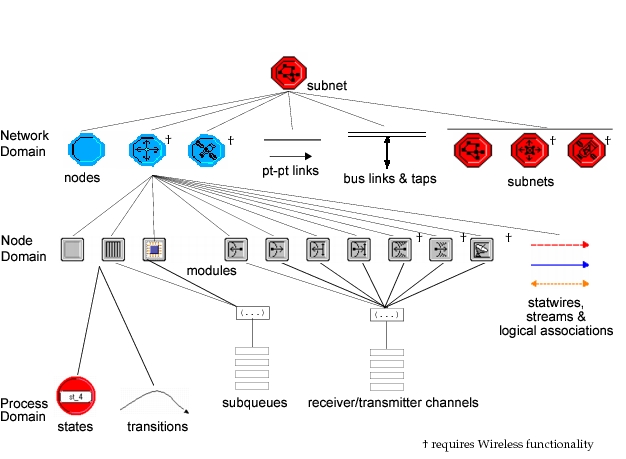
Figure 65 shows that subnets can be recursively included within subnets to form multi-level hierarchies within the network domain. All three types of node objects within the network domain can contain the same types of node domain objects. There are six types of modules (nine with the Wireless functionality), that can be combined with packet streams, statistic wires, and logical associations to form node models. Processor, queue, and esys module objects rely on the lower-level process domain to define their behavior in detail. In addition, esys modules can reference an external system definition, which specifies external code that contributes to the behavior of the module (a cosimulation).
Queue objects include multiple subordinate objects known as subqueues; which store packets. Receiver and transmitter objects for all types of links (point-to-point, bus, and radio) contain multiple subordinate objects known as channels that store and transmit packets. Process domain models consist of states and transitions that define a process’ response to interrupts.
Key Concept—Objects are hierarchically related. At the network level, subnetworks can be included within other subnetworks. Nodes and links also exist within subnets. Modules exist within node objects, and the states and transitions of a process exist within queue and processor modules. Subqueues and channels also exist within modules.
During simulation, relationships between objects are often utilized to analyze a system’s topology and to discover the context of an object. This type of analysis is typically performed by a process, and also sometimes by a pipeline stage. This technique can allow models to be developed in a more generic manner without imposing requirements on the way in which they are connected or the types of objects that are in their environment. Modeler defines a number of relationships between objects to support this type of analysis. These are listed in the following table.
Table 33: Object Relationships
| Relationship | Description |
|---|---|
| parent | Object A is the parent of object B if it encompasses or contains object B. For example a subnet is the parent of all the nodes, links, and subnets it contains; and a node is the parent of the modules that it contains. All objects have exactly one parent, except the topmost subnet, which has none. |
| child | Reverse relation of a “parent”. That is, if A is B’s parent, then B is a child of A. For example, a node is a child of the subnet in which it resides. An object may have zero, one, or multiple children. |
| input association | Object A is an input association of object B if A and B are connected and the connection supports information flow from A to B. Depending on the type of objects, the connection object may be an input association as well. Refer to the documentation for the KP op_topo_assoc() for details. |
| output association | Reverse relation of “input association”. That is, Object A is an output association of object B if B is an input association of object A. |
During simulation, processes and pipeline stages can query the Simulation Kernel for information about the objects in the system and the relationships between them by means of the Kernel Procedures (KPs) in the Topology Package. These KPs are documented in Discrete Event Simulation API.
Key Concept—Certain objects that incorporate user-defined logic can be designed to be intelligent about their environment. By calling KPs of the Topology Package, they can issue queries to discover which objects exist around them, how they are connected, and how they are hierarchically related.