Model Attributes
In many cases, processes or system components can be viewed as particular forms of more general models. Generalizations result from isolating fundamental properties of the model and determining which ones may be desirable to think of as configurable. One of the primary advantages of developing models in this way is that they become highly reusable and the modeler can benefit to a greater extent from pre-existing models. The generalized models can be thought of as model “classes” that are maintained in libraries and that can be specialized at the time they are used.
For example, a process model that implements a flow-control protocol may place a limit on the number of transmitted messages that can remain unacknowledged at any given time; this number is usually called the protocol’s window. When developing such a model, it is useful to view the window as a flexible parameter of the protocol rather than as a constant, so that if appropriate, multiple flow-control processes can be deployed as part of a system model, each with its own window size value. The second benefit is that future modeling efforts may reuse the model, even if a different window size is needed. This approach is in contrast to that of creating multiple process models, each with “hardwired” window size values.
Key Concept—A model developer may use attributes to expose appropriate control to external users. Exposing a characteristic or feature as an attribute extends the applicability of the model by allowing it to be adapted to diverse situations. The model is therefore more general and reusable.
Model attributes are defined only by the model designer; Modeler accords no semantic value to them. The knowledge of what model attributes represent and how they are to be used must be embedded by the model designer within the models themselves. In general, this type of processing of attribute assignments must be performed by program logic. This is possible both in process models and in pipeline stages (models for link behavior). In the vast majority of cases, model attributes are analyzed and processed by process models.
Key Concept—Model attributes are developer-defined and unknown to Modeler. Their meaning and use are determined by the models themselves.
Model attributes exist in three types of models:
- Process
- Node
- Link
These types of models can all be assigned to the “model” attribute of appropriate objects. When this assignment occurs (usually as part of the object instantiation), new copies of the model attributes are physically created for the object. The attributes are integrated into the object’s attribute list as though they were part of the object itself. Each object that is an instance of the model has its own private copies of the model attributes, and these can be accessed independently.
Figure 52: Inheritance of Model Attributes by Objects
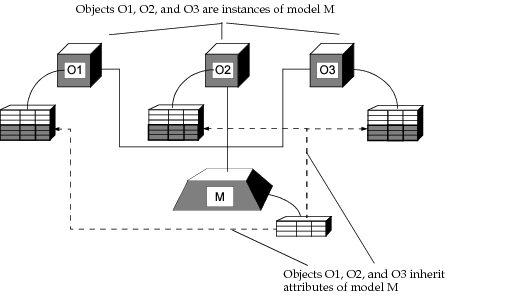
Key Concept—A model’s attributes are inherited by objects that depend on the model. They are added into the object’s set of attributes and treated as if they belonged to the object.