Derived Models
In previous sections we have seen how a model’s attribute interfaces could be used to shape the way that the model is used from an external view point. In particular specifications could be made for promoted attributes as well as a variety of other model properties. Model attribute interfaces are edited within a model and are stored as part of the model. This section presents an important mechanism called model derivation which supports applying further transformations to a model that already exists.
Frequently model developers may have a requirement to tailor a model to a user’s application. This is particularly the case for developers who are developing model libraries and customized modeling environments for their customers. In general, customization can involve development of fundamental capabilities as well as configuration of model interfaces. The goal is usually to provide a model to the user that not only performs as expected but has an external appearance and interface that appears familiar to the user.
Customization of a model can be achieved in two ways. The traditional and straightforward method is simply to rebuild or copy a model and make appropriate modifications. Modeler provides another method to do certain types of customizations without having to modify a model’s internal specifications. Model derivation allows you to start with an existing model and to create a new model that depends on it. The new model shares internal structure with the original; however, many aspects of the model’s interface can be replaced. The specifications that are in a derived model therefore consist of a reference to the original model, and information about how to configure model interfaces.
The following figure shows the relationship between the original model and the derived model.
Figure 63: Model Derivation
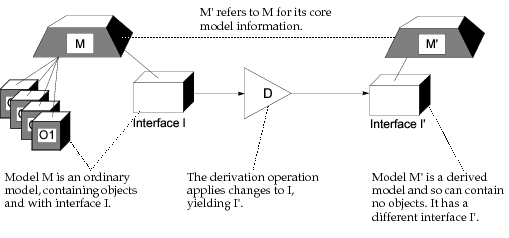
Key Concept—Developers may want to provide alternative interfaces for a model to customize it for particular applications. For this purpose, Modeler supports model derivation of node and link models. A derived model and the model it is derived from share structure, but the derived model’s attribute interfaces can be changed.
If a model M' is derived from a model M, then the relationship between M and M' can be called an “is a type of” relationship. That is, we can say that “M' is a type of M”. In concrete examples, we can say that a PC is a particular type of computer, and that a high speed router is a particular type of router. In each case, the derived model is a specialized version of the original model. The original model essentially supersets the capabilities of the derived model and can represent a wider variety of entities.
Because M' depends on M via a reference and obtains all of its internal structure from M, any changes made to M are automatically reflected in the functionality of M'. M' is said to inherit its structure from M. This inheritance mechanism is powerful because it means that changes to both M and M' can be made in one place and at one time. This avoids redundant specification and maintenance of the two models which can dramatically increase development efforts. This effect is further multiplied if multiple derivations are performed from M. For example, imagine that we have a model of a router, and from that model we want to derive low-speed, intermediate-speed, and high-speed router models. We now have 3 models all of which re-use the same core specification, and individually describe only those aspects that make them unique.
Key Concept—Changes made to a model are automatically inherited by a model that is derived from it. Therefore, the core of the model can be uniquely specified and maintained. Redundancy is eliminated, and reusability is enhanced.
The specializations that can be performed in model derivation relate to the same information that can be specified in a model’s attribute interfaces. In other words, if M' is derived from M, then M and M' can differ in the following aspects of their interfaces:
- Status of Attributes
- Properties of Attributes
- Attribute Renaming and Merging
- Model Keywords
- Supported Object Types
- Model Comments
There is an important difference between the changes that are possible during model derivation and those that occur in the original model’s attribute interfaces. Model derivation changes can apply to all attributes of the model, including those that are promoted from objects as well as those that are declared as model attributes. In other words the two sets of attributes are unified and handled together for the model derivation operation.
Key Concept—Attribute interface changes that can occur during derivation are the same that can occur when editing a model’s attribute interfaces. However, they apply not only to the model’s promoted attributes originating at objects, but to model attributes as well.
As mentioned before, each model can be used to create multiple derivations. The relationship between the models is described by referring to the original model as the parent model of each of the derived models. Each derived model can in turn be the parent of additional derived models, allowing the user to form an arbitrarily deep tree of derived models from one original model. Each new level of the tree corresponds to additional specialization of the model relative to previous derivations. The root, or base of the derived model tree is referred to as an advanced model. In other words, an advanced model is a model that is derived from no other model. The advanced model is the one that contains the core information that is shared by all of the models in the derivation tree. These relationships are shown in the following figure.
Figure 64: Model Derivation Tree
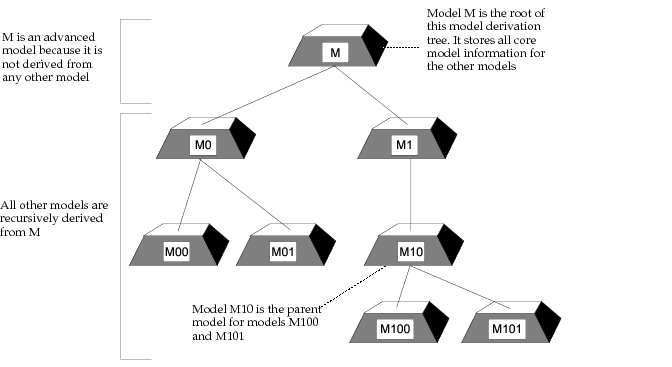
Key Concept—If model M1 is derived from model M0, then M0 is referred to as parent model of M1. A model that has no parents—such as a node model created in the Node Editor—is known as an advanced model. Derivations may be performed from advanced or derived models, forming a derivation “tree”. The root of each tree is an advanced model.