Receiver Modules
Receiver modules are instances of the receiver module type, which represents the physical devices within a communication node that receive data packets from a communications link. There are two types of receiver modules, point-to-point receivers and bus receivers, corresponding to the two types of communication links. The following figure shows the internal structure of a receiver module.
Figure 164: Internal Structure of a Receiver Module
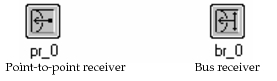
Receiver modules serve as the inbound interface between communication links outside a node and packet streams inside the node. As with transmitters, there are two types of receiver modules, corresponding to the different models of communication links: point-to-point and bus (in addition, radio receivers are available in the Wireless functionality). Each of the receiver module types has essentially the same basic behavior, although there are some differences related to the different communication mechanisms.
Receiver modules can distribute packets to one or more output packet streams upon receiving them over corresponding channels within the communications link. A packet received on a given input channel is relayed to the output stream with the same index number. Channels are subordinate objects of receiver modules. The receiver contains them within its “channel” attribute, which is a compound attribute. The “channel” attribute’s value is a compound attribute object, which is the parent of all of the contained channels (refer to “Modeling Framework” on page 80 for more information about compound attributes and subordinate objects). Each channel maintains a set of attributes that control various aspects of packet reception. Some of these attributes are also used to determine compatibility between receivers, transmitters, and link objects to form viable links in the Project Editor. Specifically the “data rate” and “packet formats” attributes of channels are used for point-to-point and bus transceiver channels. For more information, see “Link Consistency” on page 301.
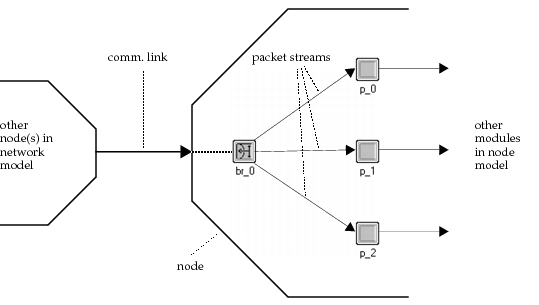
Within a node model, a receiver module is considered to be a data source. Therefore, although they may have many output packet streams, receiver modules do not have input packet streams. From the point of view of the network model, a receiver module acts as an input port, to which a communication link of the corresponding type may be connected: simplex and duplex links to point-to-point receivers, and bus links to bus receivers. These relationships are illustrated in the following figure.
Figure 165: Relationship of Receiver Modules to Network and Node Models
Many of the parameters controlling reception of packets by point-to-point and bus receiver modules are actually specified as attributes of the link, such as error rate and propagation delay.
Receiver channel objects calculate a number of statistics which can be usefully monitored by other modules via statistic wires, or collected through use of a statistic probe. For example, the “busy” statistic may be used to do carrier sensing by indicating the receipt of a packet over the link associated with the receiver. Likewise, the “collision_status” statistic of bus receiver channel objects may be used to detect the collision of multiple packets on a particular bus channel. For more details on the statistics supported by a particular receiver channel object, see “Node Reference” on page 8.