Logical Associations
Logical associations are special connections that to not actually carry data between modules. In fact, logical associations do not exist during simulation, but are used purely as specification devices. The purpose of a logical association is to indicate that a relationship exists between two modules in a node model. The existence of this relationship is used to interpret the node model’s structure.
While logical associations rely on the general concept of establishing a binding between two objects, they are currently only supported for creating associations between particular types of transmitter and receiver modules. Specifically, a point-to-point transmitter and a point-to-point receiver may be logically associated, and so may a bus transmitter and bus receiver. No other modules support this type of connection. For this reason, logical associations are also called logical transceiver associations.
The role of the logical transceiver association is to indicate that a transmitter and a receiver function as a pair. While the objects exist independently, Modeler must sometimes choose which transceivers to use when attaching nodes to links in the Project Editor. Each duplex point-to-point link, for example, makes use of one point-point transmitter and one point-to-point receiver in each of the nodes to which it is connected. Each node may contain multiple modules that can act as these “termination points” for the link. If it is important to the node modeler that a particular transmitter and receiver be used for the same attached link, then this requirement can be expressed by creating a logical association between them. This same capability can be used for bus transmitters and receivers, though it is only applicable on the end of the tap that attaches the node to the bus.
The following figure shows the effect of logical associations when creating point-point links in the Project Editor.
Figure 170: Selection of Transceivers Using Logical Association
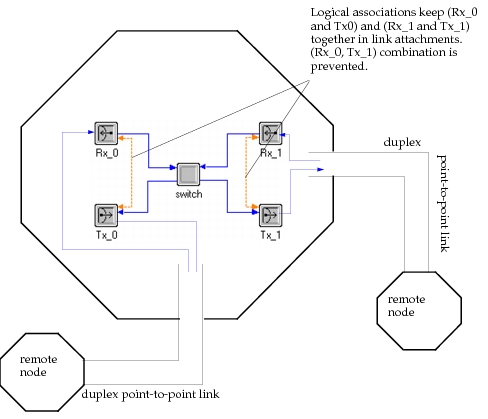
The transceiver selections made by Modeler can be manually overridden by a user. However, because most users have no visibility into the structure of node models, the concept of transceivers is foreign to them. Therefore, the user interface of other Riverbed analysis software products does not permit control of the transceiver selections, and all selections are automatically performed by the tool. For this reason, it is particularly important to use transceiver logical associations when developing models to be delivered to end-users of other Riverbed analysis software products.