Common Arguments
ODB commands can take one or more arguments that specify the targets of the command or the parameters that affect it. Although some commands have unique arguments based on the specific context of the operation, most commands share a common set of arguments. Table 25 lists the most common ODB argument types, the commands that use them, and the commands that can act as sources of the argument values.
Table 25: Common ODB Command Arguments
| Name | Description | Type | Used By | Source Commands |
|---|---|---|---|---|
<bkpt_id> |
breakpoint ID | integer | actstop, delstop, suspstop | status |
<trace_id> |
trace ID | integer | acttrace, deltrace, susptrace | status |
<process_id> |
process ID | integer | prodiag, proldiag, prostop, prolstop, protrace, proltrace, proprint | objprint, promap |
<objref> |
object reference (either numeric object ID or dot-separated hierarchical object name) |
integer or string | attrget, attrset, evprint, intdisprint, interfaceset, interfacestop, interfacetrace, intstop, mlstop, mltrace, mstop, mtrace, objassoc, objid, objmap, objprint, promap | objassoc, objid, objmap, objprint |
<pk_id> |
packet ID | integer | iciprint_pk, pkmap, pkprint, pktrace, pkstop | pkmap |
<pk_tree_id> |
packet tree ID | integer | ptmap, pttrace | pkmap |
<exec_id> |
execution ID | integer | evstop | evprint |
<sched_id> |
schedule ID | integer | evstop | evprint |
<objtype> |
object type | enumerated keyword | objmap | N/A |
<label> |
label | string | lstop, trace, mlstop, mltrace, proldiag, prolstop, proltrace | N/A |
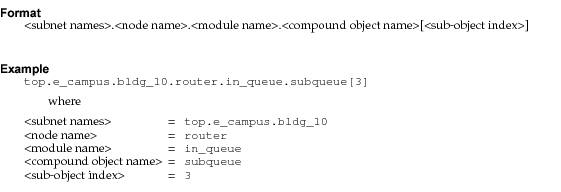
The argument type used the most in ODB is the compound type <objref> (an abbreviation of object reference). An object reference is either an integer object ID, or a hierarchical object name that is composed of the names of all nested objects which form the path to the object-of-interest from the top-level of the network model. Example formats of full hierarchical object names are given in Figure 28 and Figure 29.
Figure 28: Format and Example of a Full Hierarchical Object Name for a Normal Object
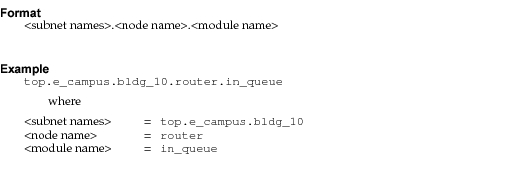
Figure 29: Format and Example of a Full Hierarchical Object Name for a Compound Object
A full hierarchical name may refer to an object contained within several nested subnetworks; in such cases, as in the example above, the subnet part of the hierarchical name actually consists of a dot-separated list of all the nested subnet names. Note that the top-level subnetwork name ("top") is optional, and may be omitted without error.
When accessing compound attribute object sub-objects, the sub-module index is used to refer to a specific child sub-object of that compound attribute object. It is used to access compound attribute subobjects such as subqueues (subobjects of queues) and channels (subobjects of transmitters and receivers).
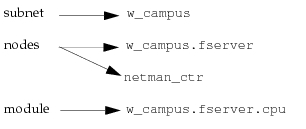
Referring to subnets, nodes, and modules using the above format is accomplished by omitting the portions of the format which fall below the object of interest. Examples of each of these types of references are shown in Figure 30.
Figure 30: Examples of Partial Hierarchical Object Names
Command Aliases
To simplify debugging, you can create command aliases for frequently used commands. Aliases map a given string of alphanumeric characters to a corresponding ODB command line portion. When processing a command, ODB tries to match the first word of the command with a list of aliases. If the match is successful, the alias is replaced by the actual command it stands for.
Table 26: Alias Commands
| Command | Description |
|---|---|
| alias | Defines an alias, or displays all defined aliases. |
| unalias | Undefines an alias. |