Communication Nodes
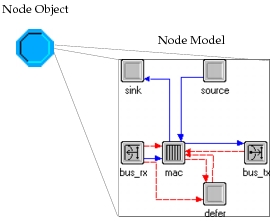
A communication node exists within a subnetwork and represents a network device with a wide range of possible capabilities. The actual function and behavior of a node is determined by its node model, which is specified by the node’s “node model” attribute. A node model is defined in the Node Editor and specifies the internal structure of the node. A node may refer to a derived node model rather than an actual node model specified in the Node Editor. In this case, there is an implicit reference to the base model that the derived model depends on. For the purposes of this section, the term node model refers to Node Domain models in general, including both base and derived node models. A node is said to be an instance of its node model. Distinct instances of the same node model operate independently of each other during a simulation, just as distinct pieces of equipment are independent of each other in a real network, although they may have identical capabilities. A network model may contain an arbitrary number of communication nodes, possibly of the same or different node models.
Figure 181: The Node Model Specifies the Internal Structure of a Node
Fixed Nodes
The basic type of communication node is a fixed node (the Wireless functionality adds mobile and satellite nodes, as described in Chapter 2 “Modeling Wireless Networks” on page 3. A fixed communication node is unable to change its position during simulation, because its “x position”, “y position” and “altitude” attributes cannot be modified during simulation. If the parent subnetwork’s region is defined in degrees, then the x position attribute is the node’s longitude, the “y position” attribute is the node’s latitude, and the “altitude” attribute value is in meters. If the parent subnetwork’s region is defined in units other than degrees, the position attribute values are also in those units and represent a location relative to the position of the parent subnetwork. See Physical Coordinate Systems for details.
Because a fixed node’s position does not change, a fixed node is typically used to model static network devices, such as workstations, gateways, and satellite ground stations. To communicate with other nodes, a fixed node is often connected to the others via one or more links. A fixed node is the only type of node that supports connections to point-to-point and bus links.
LAN Nodes
LAN nodes are a special kind of fixed node that represents an entire Ethernet, FDDI, or Token Ring LAN (local area network) and its aggregate traffic as one entity. These nodes are switched devices that contain a variable number of workstations, as well as a server. LAN nodes can be directly connected to any Ethernet, FDDI, or Token Ring node except a hub, any fixed subnetwork, or another LAN with the same data rate and protocol. LAN nodes can also be connected to other objects with different data rates (for example, a 10BaseT LAN connected to a 100BaseT LAN) by using an intermediate router or switch.