Subnetworks
Subnetworks are essentially containers that abstract the network components specified within them into one object. A subnetwork can encompass a set of nodes and links, usually to represent a physical or logical grouping of objects such as a local area network. A subnetwork can also contain other subnetworks. Subnetworks within other subnetworks form the hierarchy of the network model. This hierarchy may be extended as required to model the structure of the network. A subnetwork in the hierarchy and the objects it contains can be described in what is termed a parent/child relationship. The subnetwork is the parent of the objects inside of it and the objects are the children of the subnetwork.
A special subnetwork called the top level or global subnetwork is the highest level subnetwork in the network hierarchy. The top level subnetwork does not have a parent object. Ordinary subnetworks may be created and interconnected within this top level or within other subnetworks.
Figure 180: Subnet Hierarchy
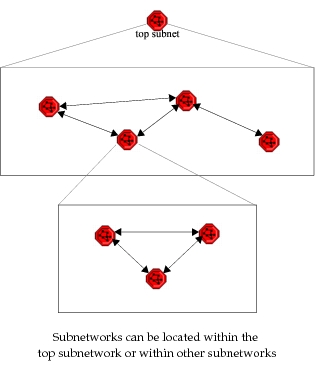
Subnetworks provide a powerful mechanism to manipulate complex network structures and to break down the system's complexity through abstraction. A large network with many components typically can be segmented into distinct parts based on the proximity, connectivity or other architectural considerations of the constituent elements. For example, a university may have several campuses, each of which is represented by a subnetwork object. Within each campus, there may be one or more buildings, each of which is also represented by a subnetwork object and so on.
Other than the objects it contains, the primary attributes of a subnetwork are its geographical position and mobility. However, a subnetwork may be used in an entirely abstract role, where its position is irrelevant during simulation and is used strictly for its ability to abstract other network level objects.
Additionally, subnetworks may exist entirely independently from each other with no interaction whatsoever. Typically, the elements of a network model do interact, but in some cases it is useful to model the elements as independent of one another. One such case is a set of experiments designed to determine the effect of interaction between subnetworks. For example, there is a proposal to join two separate Ethernet segments via a bridge. To determine the effect of the interconnection on the performance of the two Ethernets, a series of simulation runs are set up for each case: unbridged and bridged. In the unbridged case, the two Ethernets exist within the network model, but do not interact. The results of the two series of simulations can be compared to determine the effect of the bridge on performance of the Ethernets.
The basic type of subnetwork is a fixed subnetwork (the Wireless functionality adds mobile and satellite subnetworks, as described in Chapter 2 “Modeling Wireless Networks” on page 3. A fixed subnetwork is unable to change its position during simulation, because its “x position” and “y position” attributes cannot be modified during simulation. If the subnetwork’s region is defined in degrees, then the “x position” attribute is the subnetwork’s longitude and the “y position” attribute is the subnetwork’s latitude. If the subnetwork’s region is defined in units other than degrees, the position attribute values are also in those units and can, if it is not the top subnetwork, represent a location relative to the position of the parent subnetwork. See Physical Coordinate Systems for details.
Because a fixed subnetwork’s position does not change, it is typically used to model static networks. To communicate with other subnetworks, a fixed subnetwork is often connected to the others via one or more links. A fixed subnetwork is the only type of subnetwork that supports connections to point-to-point and bus links.