Statistic Wire Object
Statistic wires provide a one-way connection between a source module and a destination module. Unlike packet streams, they do not move packets from the source module to the destination module. Instead, they transfer individual values that are dynamically updated by the source module. These values may be predefined or user-defined statistics, depending on the type of the source module. Statistic wires are generally used to provide a simple interprocess communication mechanism, or to allow processes to monitor the state of other modules. Only queues and processors may act as destination modules for a statistic wire.
For more information about statistic wires, see Chapter 9 "Communication Mechanisms" on page 331.
Graphical Representation
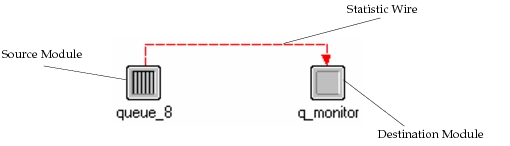
In the Node Editor, a statistic wire consist of dashed line with an arrow at the end pointing to the destination module. The following figure shows a statistic wire leaving a queue and arriving at a processor.
Figure 12: Statistic Wire
Statistic Wire Object Attributes
The following table lists the built-in attributes of a statistic wire object.
Table 26: Statistic Wire Object Built-In Attributes
| Name | Data Type |
|---|---|
| color | color |
| delay | double |
| dest stat | integer |
| falling edge trigger | toggle |
| high threshold trigger | toggle double |
| intrpt method | enumerated |
| low threshold trigger | toggle double |
| name | string |
| repeated value trigger | toggle |
| rising edge trigger | toggle |
| src stat | enumerated |
| submodule | integer |
| zero crossing trigger | boolean |