Packet Stream Object
Packet streams are essentially "pipes" which convey packets from the output of a source module to the input of a destination module (i.e., they support one-way packet flow). In the Node Editor they are displayed as a directed path indicating the direction of packet transfer between two objects. Although several colors are available to depict the streams, these do not represent functional differences. Users may want to use these colors for their own notational purposes.
Graphical Representation
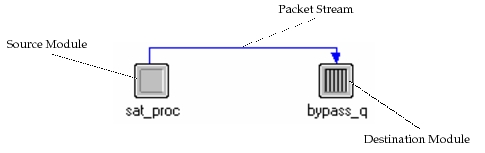
The following figure shows an example of a packet stream that connects a processor to a queue.
Figure 7: Packet Stream
Streams are designed to model the internal communication pathways of node hardware and software and are 100% reliable. No errors are injected into the transmitted packets, and packets are never dropped. Streams are considered to have "infinite" bandwidth, because it is possible for a source module to place an arbitrarily large packet on a stream and have it arrive at the destination module without any transmission delay. A fixed delay can be associated with a packet stream, so that any packet sent through the stream arrives at the destination some time after it is sent.
Modeling Delay on Packet Streams
When a packet is placed on a stream by a source module, an arrival delay may be specified; the complete packet arrives at the destination module at T + dt, where T is the time the packet is placed on the stream, and dt is the specified delay. The arrival delay is the sum of the delay associated with the packet stream (via the "delay" attribute) and the delay specified by the source module (for more information on delaying packet stream transfers, see the description of the op_pk_send_delayed() Kernel Procedure).
If no delays are used or if the same delay is used for every packet sent across a stream, packets will arrive in the same order in which they are sent. However, if stream arrival delays are varied, the order of packet arrival at the destination module does not necessarily match the order in which the packets are placed on the stream at the source module.
Stream Interrupts and Interrupt Methods
There are several different methods for transferring packets and notifying the destination module of their arrival. For streams which depart from "non-intelligent" source modules (e.g., generators, or receivers), the method to be used is designated by the "intrpt method" attribute of the stream. For streams departing from processors and queues, the value of this attribute is overridden by the choice of kernel support function used to send the packet: the Kernel Procedures op_pk_send(), op_pk_send_delayed(), op_pk_send_quiet(), and op_pk_send_forced() provide a processor or a queue with the ability to transfer a packet to a destination module via a stream and simultaneously select the method of transfer.
For a description of these KPs, see Chapter 12 "Packet Package" on page 1.
Packet Stream Object Attributes
The following table lists the built-in attributes of a packet stream object.
Table 13: Packet Stream Object Built-In Attributes
| Name | Data Type |
|---|---|
| color | color |
| delay | double |
| dest stream | integer |
| intrpt method | enumerated |
| name | string |
| src stream | integer |