Positioning your Collection Devices
Let us first address the issue of where to collect. First of all, we should ask ourselves where are all the possible places to collect traffic? The assumption made throughout this section, is that the finest grain location we would consider is the LAN segment. Because of the broadcast nature of local area network traffic on one segment, a collection device is able to observe all traffic sent to or from that segment. Placing more than one collection device on the same segment would result in redundant information.
Note that a LAN segment is not the same thing as a LAN. A LAN segment is a layer-2 physical broadcast domain, such as a shared Ethernet segment, or a token ring, or FDDI segment. If these or other layer 2 technologies are implemented in a switched environment, then each port of a switch corresponds to a distinct segment, because traffic sent on one port of the switch is not observed by stations accessible via the other ports of the switch. In VLAN environments, broadcast domains can be defined logically, but these do not qualify as segments because the switches that implement the VLANs selectively transfer traffic to their different ports.
Our objective is to build a “traffic matrix” to summarize all traffic on the network of interest over a period of time. Therefore, we need to ensure that any relevant traffic is observed by at least one collection device; otherwise it will not be accounted for. Doing this as efficiently as possible requires some knowledge of the traffic patterns. For example, as shown in the following figure, we may have prior knowledge that A and B send traffic to and from one another but send relatively insignificant traffic to C and D. And assume a similar statement could be made about traffic between C and D being exclusive with respect to A and B. Then, we could achieve collection of all inter-segment traffic with just two collection devices, as shown.
Figure 5: Minimizing the Number of Collection Devices
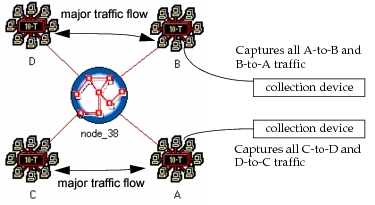
We can achieve this goal because all traffic from A to B must cross segment B and similarly for C with respect to D. In other words, in evaluating traffic volume between two segments, it does not matter on which of the two segments the collection device is positioned: in either case, the traffic will flow through it. So, which traffic flows are not measured with the two collection devices placed as shown? Any traffic between A and C is not measured, because neither has any collection devices attached. If this traffic is truly known to be insignificant for the purposes of our simulation studies, this traffic collection strategy is acceptable.
The example above serves to illustrate another important point: you must make a decision about whether you want to capture flows that are internal to segments. In the example above, neither A nor B’s internal traffic will be reflected in our traffic matrix. If you are primarily concerned about backbone (that is, inter-LAN) traffic, you can safely follow this approach. You may also be selective in collecting intra-LAN traffic for certain segments, but not others. It is important is that you are aware of the consequences of not placing a collection device at a given segment.
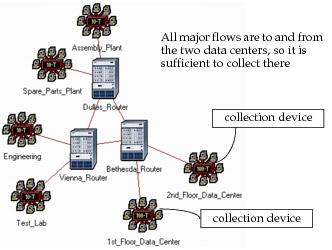
Fortunately, in many networks, we can have the type of prior knowledge we need to efficiently place collection devices. Specifically, highly centralized environments provide this type of advantage. In highly centralized environments, most traffic flows between clients and servers. These servers are concentrated in a relatively small number of facilities. Intense local traffic may also be present, but that traffic is confined to the local area network (for example, for sending jobs to a local printer). The following figure shows such a network and an effective data collection strategy for characterizing backbone traffic.
Figure 6: Collection in a Primarily Centralized Environment
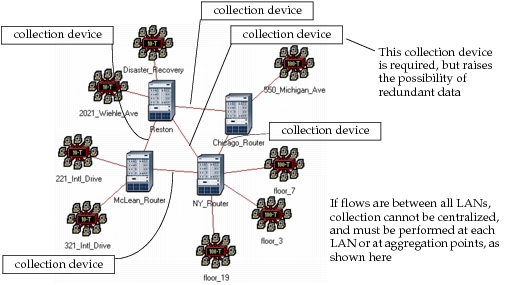
If you are unable to leverage prior knowledge of major traffic flows, as in the examples above, you may be faced with a more challenging data collection effort, requiring you to do data collection at each segment. However, for characterizing backbone traffic, you may still be able to avoid such widespread collection by looking for aggregation points. Typically, these will be at routers or switches where traffic funnels into the backbone. The following figure shows this approach.
Figure 7: Collection in a Decentralized Environment