Assigning Multiple Nodes to a Tier
When you assign multiple nodes to a tier, the import engine applies the following rules:
- If the assigned tier is the initiating tier, each replicated conversation represents an additional execution of the application task. As a result, the tier-pair traffic in the application is multiplied in the network as a whole.
- If the assigned tier is a non-initiating tier, the import engine balances traffic between all nodes that are based on the same tier. As a result, the tier-pair traffic stays constant in the network as a whole.
Examples of Multiple Node Assignments
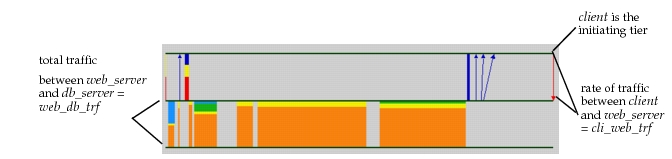
In this section, we import the same application task into three different networks and examine the resulting traffic levels. The following task involves three tiers: client (initiating tier), web_server, and database_server. We use two variables to represent the traffic levels found in the application task:
cli_web_trf= the average rate of traffic betweenclientandweb_serverweb_db_trf= the average rate of traffic betweenweb_serveranddb_server
Figure 33: A Three-Tier Application
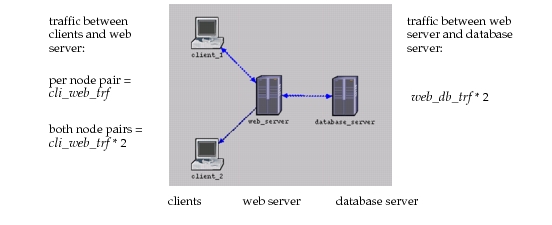
In the first example, we assign client to two workstations. Because client is the initiating tier, the imported traffic models two instances of the application; as a result, the imported traffic is multiplied by two.
Figure 34: Deployment Example 1 (Traffic Multiplied)
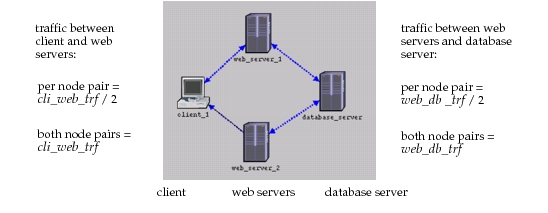
In the following example, we assign web_server to two firewall nodes. Because there is only one initiating node, there is one instance of the application. However, the network uses two web servers to carry traffic between the client and the database server. Therefore, the traffic is balanced (divided) between the replicated traffic flows.
Figure 35: Deployment Example 2 (Traffic Divided)
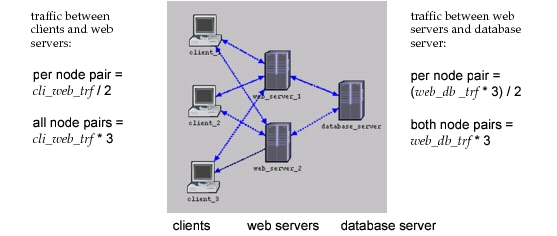
In the following example, we assign client (the initiating tier) to three workstations and web_server (a non-initiating tier) to two firewalls. The resulting traffic models three instances of the application, with the overall traffic balanced between two web servers.
Figure 36: Deployment Example 3 (Traffic Multiplied / Divided)