Bus Link Object
Bus links are a constrained broadcast medium potentially allowing every node attached to the bus to communicate with every other node on the bus. Therefore, for a bus link, there is no concept of one source node and one destination node, but rather a set of sources and a set of destinations. Nodes attach to a bus link through taps, which allow them to transmit into the bus, receive from the bus, or both.
The following figure shows a four node bus network as it appears in the Project Editor.
Figure 18: Four Node Bus Network
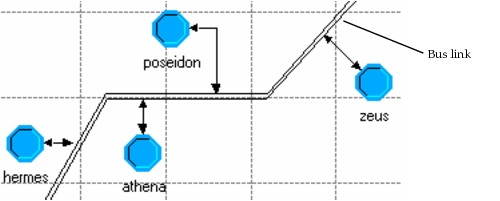
Nodes that require access to and from the bus link must contain bus transmitters and receivers. A packet given to a bus transmitter will be submitted for transmission on the bus and can potentially be received by all bus receivers which have been attached to the bus link. For more information about the bus link object, see Chapter 7 “Network Domain” on page 292.
Bus Link Object Attributes
The following table lists the built-in attributes of the bus link object.
Table 34: Bus Link Object Attributes
| Name | Editing Data Type |
|---|---|
| ber | double |
| bundle display | enumerated |
| channel count | integer |
| closure model | typed file |
| coll model | typed file |
| color | color |
| condition | toggle |
| cost | double |
| creation data | string |
| creation source | string |
| creation timestamp | date |
| data rate | double |
| delay | double |
| ecc model | typed file |
| error model | typed file |
| financial cost | string |
| label rotation | enumerated |
| line style | enumerated |
| model | typed file |
| name | string |
| packet formats | string |
| propdel model | typed file |
| role | string |
| symbol | enumerated |
| thickness | integer |
| txdel model | typed file |
| user id | integer |