Putting it All Together: the Modeling Process
You have been given a number of recommendations and techniques in this section. These techniques are generally incorporated as steps in an overall modeling process. The process is described below as a general workflow you can follow in your modeling and simulation projects. As always, you should feel free to adapt it as necessary to meet the objectives that you have set for yourself.
Figure 45: The Modeling Process
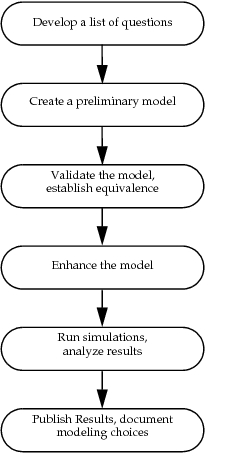
- Develop a list of questions you want the model to answer.
- Create a preliminary model that answers at least some of the questions in 1. To do this, represent those aspects of the system that you feel have the most impact on the questions of interest.
- Validate the model to gain confidence in its equivalence. For each discrepancy you find through your validation, decide if it is significant. Determine the sources of the discrepancies, if any. Correct them, and repeat this step until satisfied that you have achieved an equivalence with your real system. If you cannot achieve it with this model, you need to go back to step 2 and choose a different approach.
- Consider enhancements to your model to help you answer further questions effectively. Do these changes disturb equivalence or enhance it? Experiment with the changes and validate them to understand them. This amounts to returning to steps 2 and 3.
- When you are satisfied with your model, use it to analyze the set of cases or operating conditions you want to study for your system. For a simulation approach, this involves running simulations. Carefully examine the results of each simulation to ensure you understand them. Investigate any results that do not make sense to you.
- When you are satisfied with the model’s performance, publish your results, and document your modeling choices. This will support the appropriate use of the results, and the continued use of your model for future projects.