Traffic Handling Attributes
This section describes the attributes related to traffic handling in discrete event simulation.
Policing Parameters. This attribute is used to specify the usage policy control (UPC) function. After a connection is set up, the incoming traffic may violate the traffic contract that was requested when the connection was made. This policy control mechanism determines whether the incoming data conforms to the traffic contract specified during connection setup. The Policing functionality can be enabled by setting this attribute to either the Tagging or Discard Option.
- Tagging Option: non-conforming cells are tagged with the CLP bit set to a high value.
- Discard Option: non-conforming cells are discarded.
The Policing functionality is a dual leaky bucket implementation that polices for the peak cell rate (PCR) of the incoming traffic. In VBR virtual circuits, a dual leaky bucket polices for both the peak cell rate (PCR) and the sustainable cell rate (SCR) of the incoming cells.
Processing Parameters. Parameters used to compute processing time of the packet within a node
- VC Lookup Delay. This attribute specifies the processing delay for VP/VC (Virtual Path/Virtual Connection) Switching.
- VP Lookup Delay. This attribute specifies the processing delay for VP Switching.VC and VP lookup delays model the effect of lookup in the switching tables to determine the output VPI and VCI, since these identifiers are of local significance.
- Switching Speed. This attribute specifies how fast a cell is switched through the core switching fabric. This speed is specified in cells/sec
- Segmentation Rate. Rate at which the incoming higher layer packets are segmented into AAL PDUs.
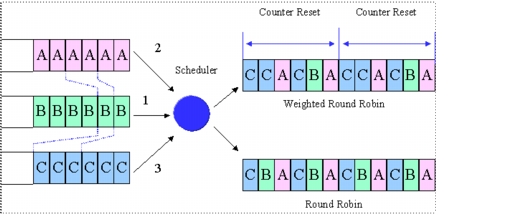
Queuing Scheme. This attribute specifies the servicing scheme for the queues. Three types of queuing schemes are available: round-robin, weighted round-robin, and priority queuing.
- Weighted round-robin scheme: queues are serviced depending on the weights assigned to them. Weights are determined according to the Minimum Guaranteed Bandwidth attribute (in ATM Queue Configuration > Queue Parameters attribute) of each queue parameter. This scheme ensures that the guaranteed bandwidth is reserved.
- Round-robin scheme: all queues have the same priority and therefore have the same chance of being serviced. The link’s bandwidth is equally divided amongst the queues being serviced.
- Priority queuing scheme: queues are serviced depending on their priority. The priority of a queue is determined by the minimum guaranteed bandwidth for the queue.
Figure 79: Servicing in Weighted Round-robin and Round-robin Schemes