VLAN
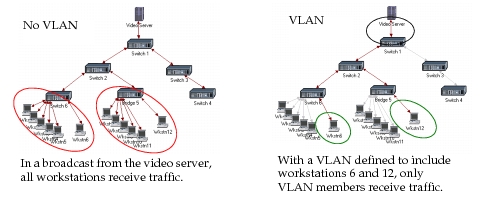
A virtual LAN (VLAN) is a group of network users and resources, logically segmented by some function, such as a project team or application, without regard to the physical locations of the nodes. Unicast, broadcast, and multicast packets are forwarded and flooded only to stations in the VLAN. Each VLAN is considered a logical network, and packets moving from one VLAN to a different VLAN must be forwarded through a Layer-3 device. Because VLANs are logically separate networks, each VLAN can support its own spanning tree over the switched network, independent of other VLANs.
VLANs have the following advantages:
- Broadcast control: Prevents traffic destined for a group of users (such as an IP multicasting group) from flooding the entire network.
- Security: Administrators have control over each port and resource.
- Flexibility and scalability: Physical location of nodes is no longer a factor.
Figure 623: Using VLANs for Broadcast Control
Note: An example project, “VLAN”, is included with the software. To access an example project, go to <reldir>\models\std\example_networks.
VLAN modeling topics: