Route Selection Attributes
Some of the important attributes relevant to route selection are described below.
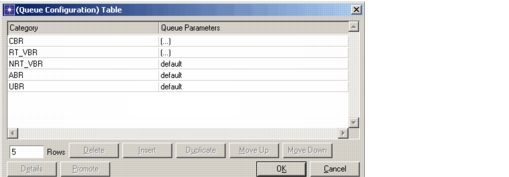
Queue Configuration. This attribute is used to specify supported parameters and to configure the queues on each port of a node. Each QoS Class (CBR, RT_VBR, etc.) may only have one dedicated queue. When a request to establish a circuit arrives at the switch, the circuit will be assigned to a given queue and will be successfully established only if the queue allows it, based on the settings of its "Queue Parameters."
Figure 77: Sample Queue Configuration
-
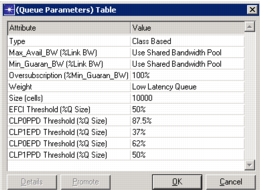
Queue Parameters: This attribute allows you to specify the amount of bandwidth that is allocated to a specific queue.
Figure 78: Dialog Box to Specify Queue Parameters
-
Max_Avail_BW (% Link BW): This is the maximum bandwidth available to this queue. It is calculated as a percentage of the link bandwidth. For CBR calls, this attribute regulates the maximum bandwidth reserved and hence guarantees this bandwidth as well.
-
Min_Guaran_BW (% Link BW): For non-CBR queues, this is the amount of bandwidth allocated to the given queue, specified as a percentage of the total link bandwidth. An incoming request to establish a circuit will be granted if there is enough bandwidth in this queue to satisfy the request. The amount of bandwidth allocated to each circuit out of the total bandwidth pool of the queue is determined by the circuit's traffic parameters and is computed by the CAC algorithm. The special value "Use Shared Bandwidth Pool" allows multiple queues to share the same bandwidth pool, rather than fixing the amount of bandwidth for each queue.
-
Oversubscription (%Min_Guaran_BW). Configuring oversubscription extends the virtual bandwidth pool available to the queue, resulting in the acceptance of more circuits. However, it also loosens the quality of service guarantees by allowing more circuits to be established than the available real bandwidth would otherwise allow. This may lead to performance degradation for the traffic that uses these circuits in cases of heavy network utilization. A value of 100% oversubscription indicates no extension of the real bandwidth pool (i.e., the real available bandwidth pool of the queue will be used, as specified in Min_Guaran_BW for non-CBR queues and the Max_Guaran_BW for CBR queues).
-
The following equation holds true for non-oversubscribed ports.
Maximum Available Bandwidth of CBR queues + Minimum Guaranteed Bandwidth of non-CBR queues = 100% -
Size: This attribute determines the number of cells in the queue.
-
The Queue Configuration attributes described above, as well as the CTD/CDV/CLR limits on the port, are instrumental in determining the route taken by an ATM circuit. These parameters define the default values for each port on an ATM device; however, they can also be modified on a per-port basis using the Per-Port Configuration attribute.
To compute the route of a circuit through the network, the shortest path that satisfies the requested traffic parameters for the circuit is determined. The decision of whether a circuit will be admitted on a given ATM interface is made by using CAC to compute the equivalent bandwidth of the circuit from its traffic parameters (see "CAC Configuration" in the following section) and by checking the request against the currently available bandwidth in the queue corresponding to the QoS of the circuit, as well as the CTD/CDV/CLR connection limit constraints. If enough bandwidth is available to grant the bandwidth request, the circuit will be admitted, and the currently available bandwidth for subsequent circuits will decrease accordingly.
SPVC Reroute Parameters. This compound attribute specifies the number of SPVC reroute attempts and the time between the attempts for re-routing SPVC connections on failure.There are link attributes to export reports on a particular link:
- ATM Link Failure Report: Exports the number of VCs traversing the link at the time of failure, number of rerouted connections and the paths taken by the rerouted connections
- ATM Trunk Report: Exports the number of VCs traversing the trunk at the specified time and the bandwidth allocated on the trunk at the specified time
Connection Limit. Specifies the maximum number of call requests that the switch may accept at a given time.
CAC Configuration. (Flow Analysis only) This attribute specifies the Call Admission Control (CAC) algorithm the node will use. The CAC algorithm determines how much of the available bandwidth for a queue must be allocated to each incoming call request, based on its Traffic Parameters, and will accept/deny the request based on the availability of resources in the queue. The default algorithm converts the Traffic Parameters to a bandwidth allocation request using the following rules:
Table 20: CAC Configuration Rules
| Traffic Class | Bandwidth Allocation Request |
|---|---|
| CBR | PCR |
| RT_VBR, NRT_VBR | A value between SCR and PCR |
| ABR | MCR |
| UBR | 0 bps |
Setting the CAC algorithm to "Lucent" enables Lucent's CAC algorithm using the values configured under "Lucent CAC Parameters." Additionally, you can supply your own custom CAC implementation in an external Python file. Consult the file Guerin_cac.py for an example of the interface.