Software-Defined Networking
Software-defined networking (SDN) is a dynamic, vendor-neutral architecture that separates the network control and forwarding functions from the underlying infrastructure. This allows the network control plane to be programmable, while the network infrastructure may be abstracted for applications and services.
This document describes key features of the SDN model for discrete event simulation (DES). The SDN model is based on OpenFlow Switch Specification v1.3.0 of OpenFlow protocol.
Note: When a switch initiates a connection with a controller that is not running OpenFlow v1.3.0, the switch will attempt to perform version negotiation so that the controller can operate in v1.3.0. This eases the configuration when using the switches with controllers that support version negotiation without having to explicitly set the controller's OpenFlow version.
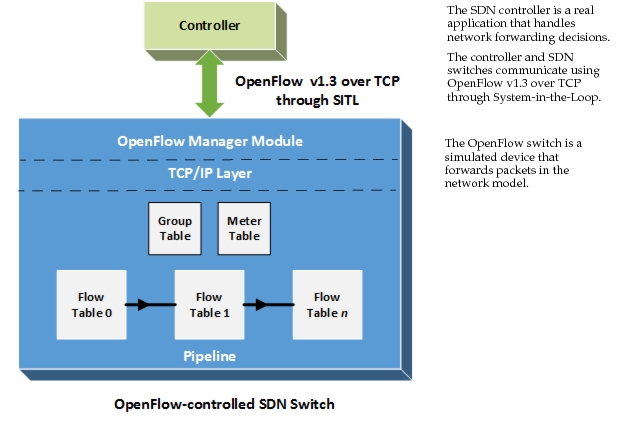
The following figure shows a simple overview of the components of an OpenFlow-controlled SDN switch. Notice that the switch has one or more flow tables, a group table, and a meter table.
Figure 470: Components of an OpenFlow-controlled SDN Switch
Note: An example project, "SDN", is included with the software. To access the example project, go to <reldir>\models\std\example_networks\Modeler.
SDN modeling topics: