Traffic Engineering
Multicast traffic flow depends on
- RP position
- Multicast routing configuration
- Static routing table
- IP unicast routing table
Dependency on RP Position
You can use Riverbed Modeler to study the optimal placement of an RP. RP placement is important if routers do not use the default behavior to switch to the shortest path tree after the first packet is received. To study how RP position affects network performance, compare scenarios with different RP positions in the network.
For more information about configuration RPs, see Rendezvous Point (RP) Selection.
For more information about creating multicast trees, see Multicast Tree Visualization.
Dependency on Multicast Routing Configuration
After you create a baseline scenario, you can modify the list of interfaces that support multicast to see how the demands are routed and how throughput is affected.
Dependency on Static Routing Configuration
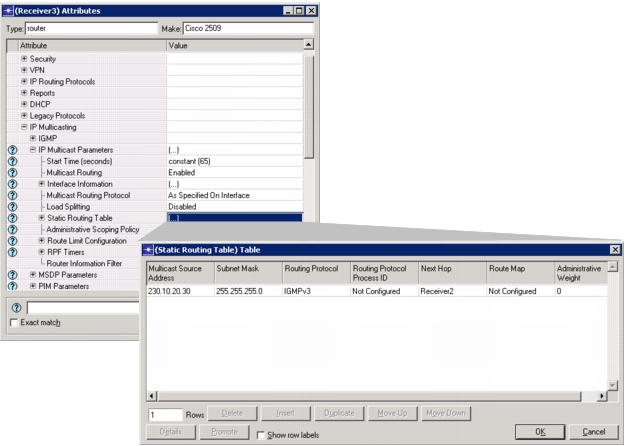
You can use static routes for multicast traffic. The next-hop address can be either an IP address or a point-to-multipoint LSP, as shown in Figure 240. For more information, see "Point-to-Multipoint LSPs" on page 6.
Figure 240: Static Routing Table
Dependency on Unicast Routing Table
Shared Tree Route from Source to the RP
Before the SPT switch, multicast packets are sent from the source towards the RP encapsulated in unicast packets. As a result, their route is determined by the unicast routing table. To modify the route, make changes that lead to the modification of the unicast routing table.
SPT Route
When a designated router starts an SPT switchover process, it sends a join message towards the source. The path of this message determines the path of multicast traffic sent from the source to the designated router via SPT. To modify this path, make changes that lead to the modification of unicast routing table.