Point-to-Multipoint LSPs
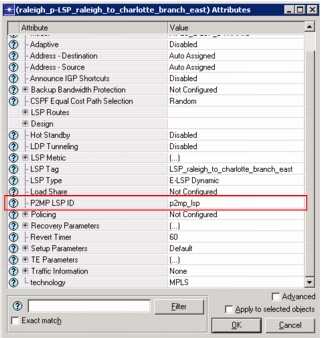
Point-to-multipoint (P2MP) LSPs are similar in nature to IP multicast except that they use MPLS for data redistribution. In point-to-multipoint LSP configuration, a primary LSP contains branch or sub-LSPs that are configured to send traffic on to multiple destinations. Though the traffic is going to multiple destinations, only one copy of the traffic is sent over common links. Similarly, bandwidth reservation over common links is shared. Riverbed Modeler supports the import of point-to-multipoint LSPs from Juniper routers when importing from either SteelCentral NetCollector or device configuration files (using eXpress Data Import). A P2MP LSP is represented as a set of branch LSPs, each represented by any of the connection objects that would represent an ordinary point-to-point LSP. The P2MP LSP ID attribute on each LSP identifies the LSP as a branch LSP of the given P2MP LSP. This attribute is also used to name the P2MP LSP, as shown in the following figure.
Figure 387: P2MP LSP ID Attribute
Note: P2MP LSPs are not supported for discrete event simulation. You must use Flow Analysis.
You can use a combination of static routes, multicast, and LSPs in the network, simplifying configuration, as shown in Figure 388. Note that in this case the P2MP LSP is used to route traffic through the PIM-free provider core between client-side PIM networks rather than end-to-end multicast routes. (For more information about multicast, see “IP Multicast” on page 1).
Figure 388: Combination of Static Routing and PIM in a Network Model
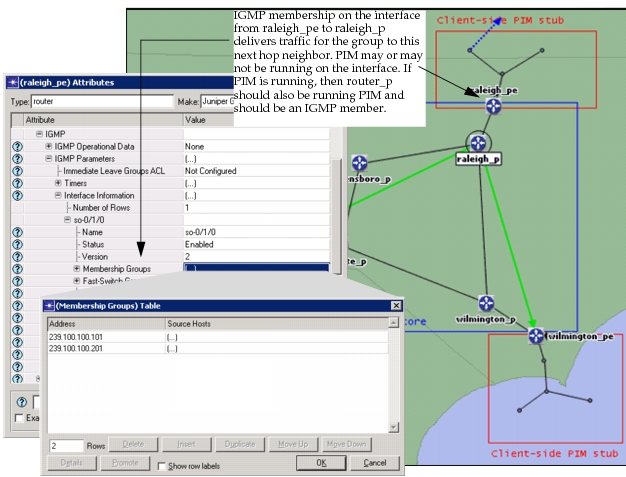
This is just one example of a supported configuration. Alternatively, Riverbed Modeler supports a configuration in which the P2MP LSP originates at the PE router. In that instance, the PE router (e.g., raleigh_pe) puts traffic on the LSP via a static route.
Note: The static route need not be a P2MP LSP. Other types of static routes are supported.
The Raleigh client-side PIM network is the source of the multicast traffic (shown by the dotted blue arrow in Figure 389). The traffic is delivered to other client sites running dynamic PIM over the PIM-free provider core using P2MP LSPs.The router raleigh_p has static route entries that route the multicast traffic over the P2MP LSPs using the P2MP LSP ID to specify the next-hop in the path. Static routes can include next-hops of an IP address, an interface, or, in the case of multicast, a P2MP LSP. In Figure 389, two P2MP LSPs are configured: one is colored green and one is colored purple. These P2MP LSPs will carry two multicast demands: 239.100.100.101 (green) and 239.100.100.201 (purple). The static routing table for raleigh_p is shown. Notice that the route to the multicast groups has a next-hop type of P2MP LSP.
Figure 389: Point-to-Multipoint Routing - Static Routes Using P2MP LSP
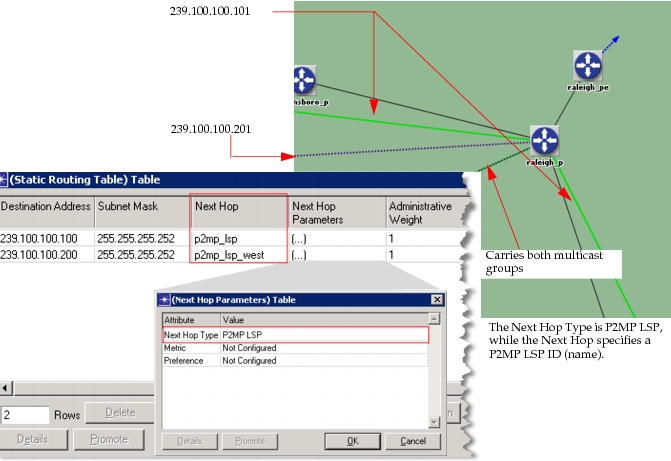
The P2MP LSPs route the traffic to the destination network, which could also be another dynamic PIM network segment, as shown in Figure 388.
Point-to-Multipoint LSPs in Network Browser
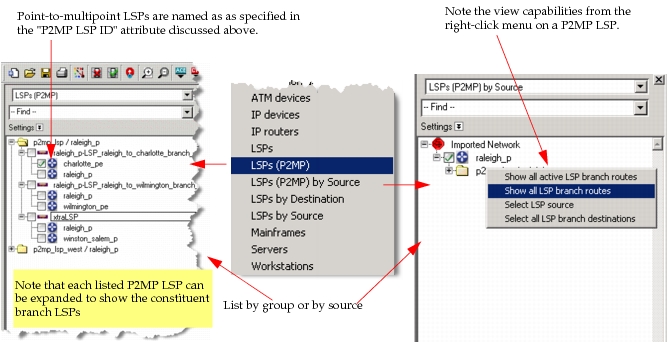
You can view point-to-multipoint LSPs in the Network Browser. You can list P2MP LSPs by group or by source, as shown in the following figure.
Figure 390: P2MP LSPs in Network Browser
Note the following:
- LSPs having the same P2MP LSP ID are grouped together
- Right-clicking on a P2MP LSP ID lets you
- Show all LSP branch routes, which displays the P2MP tree
- Select a P2MP source or all destinations