Model Architecture: IP Multicast
The following diagram illustrates the relevant portions of a typical node model using the process models defined for the IP multicasting model suite.
Figure 272: Multicast Modules
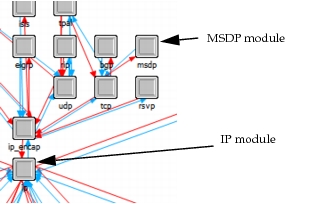
Each node intended to use IP Multicast has an IP module, which spawns IP Multicast processes as child processes. In addition, an MSDP module interfaces with TCP to establish peering and to transfer SA messages for use with Anycast RP.
IP Multicasting is implemented through the following process models.
Table 118: IP Multicast Process Models
| Process Model | Description |
|---|---|
| ip_igmp_host | Implements the Internet Group Management Protocol (IGMP) in hosts. |
| ip_igmp_rte_intf | Implements the IGMP in routers (with ip_igmp_rte_grp). ip_dispatch spawns an instance of this process for each interface that supports IGMP. |
| ip_igmp_rte_grp | Implements the IGMP in routers (with ip_igmp_rte_intf). ip_igmp_rte_intf spawns a child instance of this process for every multicast group in the subnetwork. |
| ip_pim_sm | Implements the Protocol-Independent Multicasting - Sparse Mode (PIM-SM) multicast routing protocol in router nodes. This runs as a child process of ip_dispatch. |
| msdp | Implements the Multicast Source Discovery Protocol in router nodes. |
| msdp_conn | Manages connections with MSDP peers. msdp spawns a child instance of this process for every peer. |
Figure 273: Multicasting Operation: Joining a Group
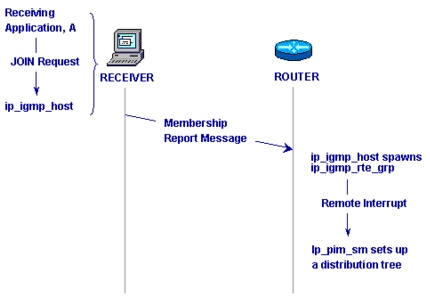
The following sequence occurs when a host joins an IP multicast group:
-
Application A joins a multicast group, Group 1, by sending a join request to the ip_igmp_host process using a remote interrupt.
-
The ip_igmp_host process sends an IGMP Membership Report message to the ip_igmp_rte_intf process on the neighboring multicast router.
The IGMP Membership Report informs the neighboring multicast router that a local host has joined Group 1.
-
The ip_igmp_rte_intf process (on the router) spawns an ip_igmp_rte_grp process to handle Group 1.
-
The ip_igmp_rte_grp process sends a remote interrupt to the ip_pim_sm process, signifying that a local host has joined Group 1.
-
The ip_pim_sm process sets up a distribution tree for Group 1 so that packets sent to the group can be received Application A.
Figure 274: Multicasting Operation: Sending Traffic to a Group
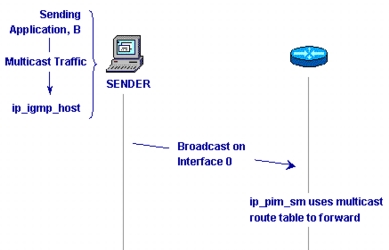
The following sequence occurs when a host sends packets to an IP multicast group:
-
Application B (shown in violet in Figure 273) sends a packet to a multicast group.
Note: If the sender is part of a LAN, each node on the LAN receives the multicast packet. The multicast packet is dropped by the IP process of workstations that do not belong to the multicast group. Otherwise (if the workstation belongs to the multicast group), the workstation’s IP process forwards the packet to its upper layers.
-
The router’s IP process forwards the multicast packet to the ip_pim_sm process.
-
The ip_pim_sm process on the router creates and sends one copy of the multicast packet for each out interface specified in the multicast route table.
Debugging Information
The following traces are available for debugging purposes.
Table 119: IP Multicast Traces
| Trace | Description |
|---|---|
| pim-sm | Prints full debug information related to PIM-SM operation |
| pim-sm_all_but_data | Prints debug information related to everything except the handling of multicast data |
| pim-sm_data | Prints debug information related to only multicast data packets |
| pim-sm_hello | Prints debug information related to only Hello messages |
| pim-sm_join_prune | Prints debug information related to only Join/Prune messages |
| pim-sm_timers | Prints debug information related to only the setting and expiring of PIM timers |
| igmp | Prints debug information related to IGMP operation |
| msdp | Prints debug information related to MSDP operation |
The following diagnostic blocks are available for debugging purposes.
Table 120: Diagnostic Blocks
| Diagnostic Block | Description |
|---|---|
| pim-sm | Prints the PIM-SM routing table and group-to-RP mapping table. |
| ip_igmp_rte_intf | Prints a list of groups for which an IGMP join message was received over an interface. |