Source Specific Multicast
Source Specific Multicast (SSM) is a method of delivering multicast packets in which the only packets that are delivered to a receiver are those originating from a specific source address requested by the receiver. The receiver must specify the source address, which is possible when using IGMPv3. (See IGMP.) By so limiting the source, SSM reduces demands on the network resources and improves security. For example, in the following figure two senders exist: Sender1 and Sender2. Each sender is a source for the same multicast group. Receivers can specify one of these sources from which they wish to receive multicast packets.
Figure 227: SSM Network Model
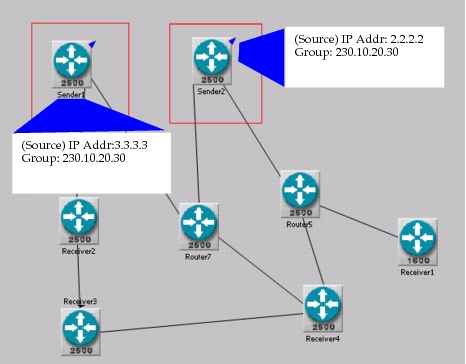
For example, if Receiver1 wants to receive multicast traffic from Sender1 only, the IGMP configuration must specify a source and group pair, in this case (3.3.3.3, 230.10.20.30), which is distinct from (2.2.2.2, 230.10.20.30).
You can import network models configured with SSM. Flow Analysis supports the following SSM characteristics of imported network models:
- SSM Address Mapping—Address mapping specifies an access list and source address, which allows the router to use a statically configured list to translate (*,G) memberships to (S,G) memberships.
- SSM Address Range—SSM can coexist with standard multicast service by applying the SSM delivery model to a configured subset of the IP multicast group address range. IP multicast receivers have to subscribe using (S,G) to receive traffic. Those with (*,G) (with G being the group), specified using this attribute would not receive traffic See also Figure 228.
The SSM range must also be defined to enable multicast tree construction. The receiver can specify a specific address (i.e., 230.10.20.30/32) or a broader range of addresses that includes all potential groups in a range (i.e., 230.0.0.0/8). The latter example is shown in the following figure. If hosts subscribe to this router as a (*, 230.10.20.30) but not as a (S, 230.10.20.30), then by virtue of SSM address range configuration, they will not receive traffic.
Figure 228: SSM Range Attribute
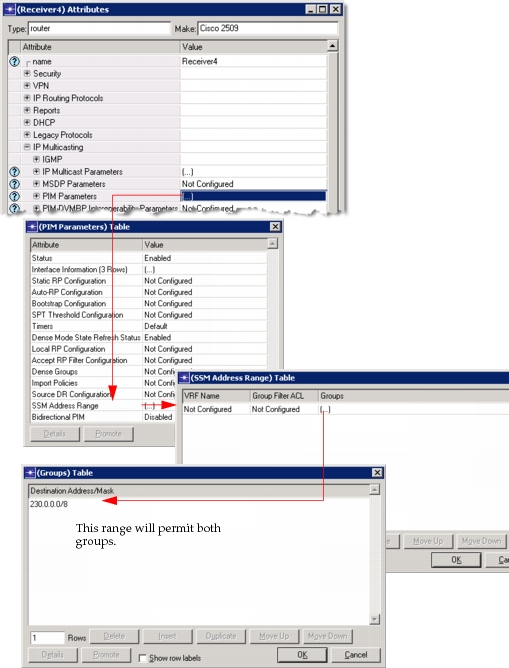
Note: If the SSM range is configured on intermediate routers between the sender and receiver, (*, G) joins in that range will fail.
Here are a few benefits you may realize from using SSM:
- SSM eliminates the requirement to use RP configurations, thereby reducing network complexity
- SSM eliminates security risks such as denial-of-service (DoS) attacks because receivers are restricted to receive multicast traffic from specific sources only
- SSM eliminates the need for unique values of multicast groups across an administrative domain, since it only requires unique source/group (S,G) pairs. For example, a receiver can subscribe to Sender1 for video feeds on Group1 and can also subscribe to Sender2 for telemetry data on Group1. The multicast group address can be reused.
- The SSM address range can be configured in such a way as to distribute multicast trees across a network to provide traffic engineering across multicast groups. For example, a network could be configured so that all north-side routers support groups G1-G10 and all south-side routers support G10-G20.