IGMP
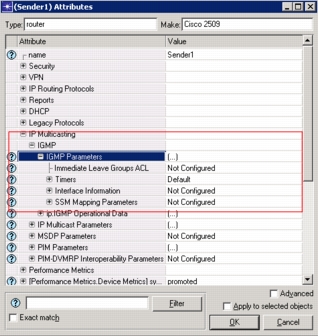
Riverbed Modeler supports versions 1, 2, and 3 of Internet Group Management Protocol (IGMP). Attributes for IGMP are shown in the following figure.
Note: IGMPv3 is supported for Flow Analysis only.
Figure 224: IGMP Attributes
Note: When multiple versions of IGMP are running on a subnet, routers select the lowest common version of IGMP.
The latest version of IGMP, IGMPv3, allows a host to subscribe to multicast groups on a given source node, thereby supporting Source Specific Multicast. The following features of IGMPv3 are supported:
- IGMP configurations on unconnected interfaces are supported, even if the "Consider all unconnected interfaces" checkbox in the Configure/Run Flow Analysis dialog box is not selected
- The following features are supported for IGMP operational data:
-
The multicast routing table is imported along with the IGMP group data. If the group data is missing, IGMP groups are inferred from the information in the multicast routing table.
Note: To enable this inference, the "Infer IGMP Operational Data From Multicast Route Table" preference should be set to TRUE before starting the import.
-
When operational multicast group data is imported from NetCollector, Flow Analysis uses this data to construct multicast trees and route network traffic flows.
-
- All group information for IGMPv3 is imported into Riverbed Modeler. IGMPv3 has two modes: include and exclude.
- Include—The receiver announces membership to a host group and provides a list of IP addresses from which to receive traffic, implicitly excluding all other sources.
- Exclude—The receiver announces membership to a multicast group and provides a list of IP addresses from which it does not want to receive traffic. This indicates that the host wants to receive traffic from all sources except those in the specified list. To receive traffic from all sources, a host can use exclude mode membership with an empty exclude list.
- Message priority. You can set the priority of IGMP messages exchanged in the entire network by specifying the DSCP marking of the messages using the corresponding global attribute. The default value is CS6.