Supported Configurations
You can configure your UMTS network model to use either of the following configurations:
- UMTS workstation nodes routing application traffic (e-mail, ftp,...) through one or more CN nodes to other UMTS workstation or server nodes, or to workstations and servers running over other technologies, such as Ethernet or WLAN.
- UMTS station nodes sending generic data traffic to other UMTS station nodes though a single or multiple SGSN nodes.
You cannot send application traffic to a UMTS station node, nor can you send traffic generated by a station node to a UMTS workstation or server node. When using the UMTS workstation nodes, use the application models to generate traffic as you would for any workstation node. See the application model documentation for additional information on configuring application traffic.
Using the station and SGSN nodes allow you to configure a traffic generation pattern that is not application-based. This avoids the need to use the application models when you are not interested in application-specific performance in the UMTS network. Consider using the station nodes and SGSN nodes when the following apply:
- You want to model raw traffic data within the UMTS network
- You are not interested in the external IP network
- You are not modeling CN to CN data transfer
The following figures show the supported types of UMTS network configurations.
Figure 579: Simple UMTS Network Using Application Traffic
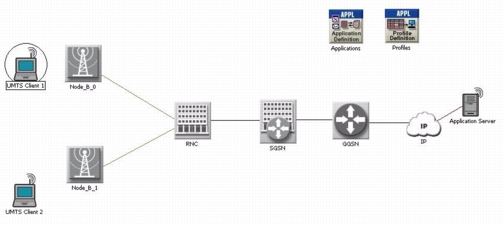
Figure 580: Simple UMTS Network Using Raw Traffic Generation
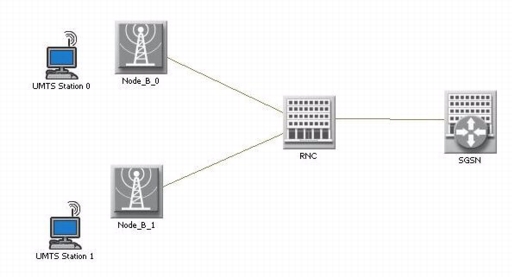
You can also model a UMTS topology in conjunction with LTE in the same scenario, using an LTE EPC node in substitution of the GGSN. For more information, see "Support for UMTS Networks" on page 58 in "LTE".