CN Architecture
The model includes two options for modeling CN nodes:
-
CN node models combine SGSN and GGSN functionality.
- Gateway CN node: generic gateway nodes that include SGSN and GGSN functionality
- Simple CN node: a simple SGSN node that includes UMTS functionality and packet-switching functionality between the SGSN’s UE station nodes
See CN Node Models.
-
SSGN and GGSN node models let you model the CN components individually:
- GGSN nodes
- SGSN nodes: generic SGSN nodes that can connect to up to 8 RNCs and one GGSN
See SGSN Node Models and GGSN Node Models.
CN Node Models
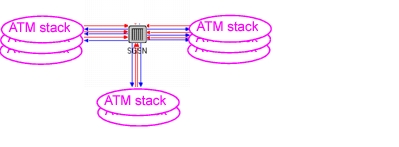
The simple CN node model (Figure 599) includes the SGSN module and variable ATM stacks for communications with the RNCs. You can configure the nodes’s Network Delay attribute to model the delay that would be introduced by the network cloud between the source and destination UMTS network within the node model.
Figure 599: Simple CN Node Model: umts_sgsn
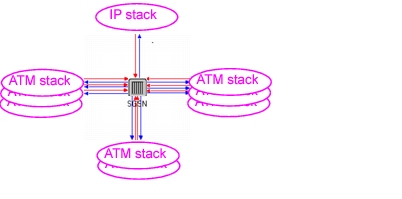
The gateway CN node models, umts_ethernet_slip8_gtwy or umts_ethernet_slip8_large_gtwy, include the SGSN module, variable ATM stacks for communications with the RNCs, and a router node protocol stack with an IP module and IP interfaces running other layer-2 technologies.
Figure 600: Gateway CN Node Mode
l
GGSN Node Models
The model suite includes three GGSN node models, umts_ggsn_slip8 umts_ggsn_atm8_ethernet8_slip8, and umts_ggsn_ethernet2_slip8. The GGSN node models are similar to the gateway CN node model, except that they do not include the SGSN module and ATM stacks. The GPRS Tunneling Protocol (GTP) runs in the IP module on these nodes and sets up GTP tunnels between the GGSN and SGSN.
SGSN Node Models
The model suite includes two SGSN node models, umts_sgsn_ethernet_slip and umts_sgsn_atm_ethernet_slip. The SGSN nodes are similar to the simple CN node model, except that they also include an ATM, Ethernet, or IP interface to connect to a GGSN node as Gn interfaces. The GPRS Tunneling Protocol (GTP) runs in the IP module on these nodes and sets up GTP tunnels between the SGSN and GGSN.
SGSN Module
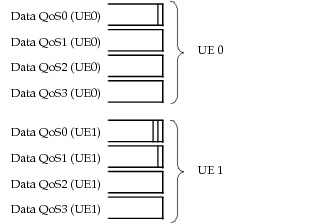
The SGSN module is modeled as a queue and is common to both CN nodes and to the SGSN nodes. The number of queues depends on the number of users in the cells and on the number of QoS classes supported per user. Data packets arriving at the CN node are queued when no PDP context has been activated for that QoS class or when no channel has been set up with the terminating UE. The packets are queued by QoS class as shown in Figure 601. If the PDP context is already activated for the packet’s QoS class and if a channel is already set up, the packet is transparently forward to the RNC.
Figure 601: Queue Structure in the SGSN Module
CN Process Model
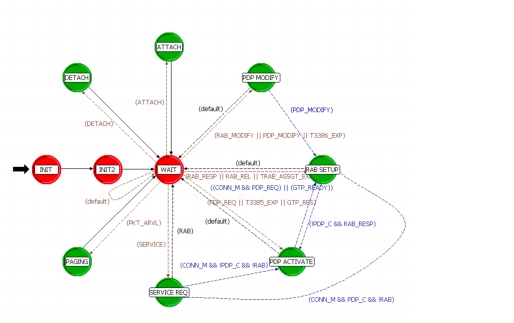
The process model that resides in the SGSN module of the CN node model is shown in Figure 602. The current model implements the GPRS attach procedure, PDP context activation, and RAB establishment and release. The paging state is used to receive data packets from the RNC or IP network.
The current release does not model the following:
- GPRS detach state
- PDP context deactivation state
- Security state
Figure 602: SGSN Process Model