Radio Resource Management
Radio resources are allocated to the mobile station in a very flexible manner depending on the level of activity and the amount of data that needs to be sent. Packets can be sent over the physical random access channel (PRACH), the physical common packet channel (PCPCH), or the dedicated physical data channel (DPDCH). For a small amount of data, the PRACH is normally used. For small to medium amounts of data, the PCPCH is preferred. For large amounts of data, the DPDCH can be used.
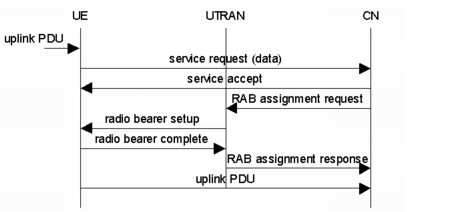
On receipt of PDUs from higher layers, the UE begins the RAB (Radio Access Bearer) Assignment procedure if no radio bearer has been established. If these PDUs do not belong to a quality of service for which a PDP context has been activated, the UE first initiates the PDP Activation Procedure. On the other hand, if a PDP context already exists, the UE initiates the RAB Assignment procedure by sending a Service Request message to the 3G-SGSN as shown in Figure 6. The Service Request procedure is used to setup a PS signaling connection with the network if the UE is in PMM-Idle State or to request resource reservation to the network if the UE is in PMM-Connected State. In the RAB Assignment procedure, the 3G-SGSN sends a RAB Assignment Request message to the UTRAN to establish one RAB. The UTRAN establishes the appropriate radio bearer by sending a Radio Bearer Setup message to the UE if there is sufficient uplink and downlink capacity available to support the new radio link. On receipt of a Radio Bearer Setup message, the UE setups the appropriate radio bearer as specified by the UTRAN. Once a radio bearer is set, the UE can start sending/receiving PDUs on the uplink/downlink.
Figure 622: RAB Assignment Procedure