Creating a UMTS Network Topology
Available Node Models
The node models shipped as part of the UMTS specialized model library are grouped in the UMTS and UMTS_advanced object palettes.
Figure 578: UMTS Object Palette
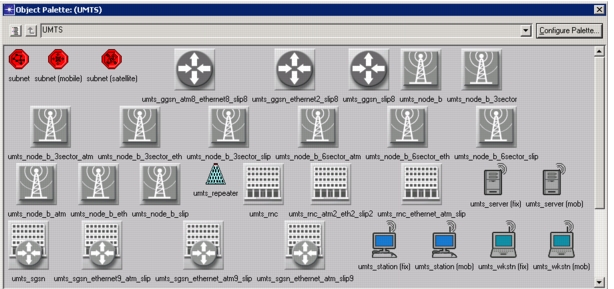
Table 235: Node Models
| Node model | Description | |
|---|---|---|
| UE | umts_station |
General client node that includes UE and generic traffic generation functionality. This node can only send traffic to (and receive traffic from) other umts_station nodes served by the same SGSN. |
umts_wkstn |
General workstation node (with full OSI stack) that includes UE and client/server application functionality. | |
umts_server |
General server node (with full OSI stack) that includes UE and client/server application functionality. | |
| UTRAN | umts_node_bumts_node_b_atmumts_node_b_ethernetumts_node_b_slip |
Node-B portion of the UTRAN. |
umts_node_b_3sectorumts_node_b_3sector_atmumts_node_b_3sector_ethernetumts_node_b_3sector_slip |
Node-B portion of the UTRAN. This node_b model has 3 directional antennas, which handle connections with the UEs in their sector. | |
umts_node_b_6sectorumts_node_b_6sector_atmumts_node_b_6sector_ethernetumts_node_b_6sector_slip |
Node-B portion of the UTRAN. This node_b model has 6 directional antennas, which handle connections with the UEs in their sector. | |
umts_rncumts_rnc_ethernet_atm_slipumts_rnc_atm2_eth2_slip2 |
RNC portion of the UTRAN. | |
| CN | umts_sgsn |
Simple CN node—has core network functionality, but does no IP routing. Routes packets to and from umts_station nodes, exclusively. |
umts_ethernet_slip8_gtwyumts_ethernet_slip8_large_gtwy |
Gateway CN node—general gateway node that includes SGSN and GGSN routing functionality and Ethernet and SLIP interfaces. Used only in networks with umts_wkstn and umts_server nodes. Not used with umts_station nodes. | |
umts_ggsn_slip8umts_ggsn_atm8_ethernet8_slip8umts_ggsn_ethernet2_slip8 |
GGSN portion of the CN | |
umts_sgsn_ethernet9_atm_slipumts_sgsn_ethernet_atm9_slipumts_sgsn_ethernet_atm_slip9 |
SGSN portion of the CN | |
| Repeater | umts_repeater |
Add to extend coverage area of Node-B cell, improve signal strength (especially in downlink), and get around physical obstacles. |