Mobility Management and Session Management
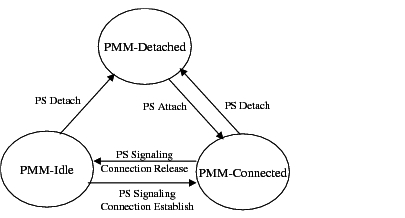
Figure 621 shows the Packet Mobility Management (PMM) States for UMTS only. These functions are handled in the GMM layer of the UE and 3G-SGSN in Figure 620. A mobile station cannot use GPRS services before registering in the GPRS network. A mobile station is in the Packet Mobility Management Detached (PMM-Detached) State if it is not registered in the GPRS network as shown in Figure 621. In that state, there is no communication between the UE and the 3G-SGSN. The 3G-SGSN cannot reach the UE because it has no valid location or routing information for the UE. The UE makes its presence known to the network by performing the GPRS Attach procedure. This makes the UE available for paging via the 3G-SGSN.
A PS (Packet Switched) signaling connection is also established between UE and 3G-SGSN by performing the GPRS Attach procedure. When the PS signaling connection is established between the UE and 3G-SGSN, UE and 3G-SGSN move to the PMM-Connected State. The PS signaling connection consists of an RRC connection between UE and UTRAN and an Iu connection between the UTRAN and 3G-SGSN. If the PS signaling connection is released or broken, the UE and 3G-SGSN move to the PMM-Idle State.
Once in the PMM-Connected State, the mobile station needs to request a Packet Data Protocol (PDP) address used in the Packet Data Network (PDN) if it wants to exchange packet data with external packet networks. The mobile station accomplishes this by activating the PDP context that it wants to use. The PDP context characterizes the session. It includes the PDP type (such as IPv4 or Ipv6), PDP address, QoS requested, etc. With an active PDP context, the mobile station is known to external packet data networks and can send and receive PDP PDUs. The MS and SGSN can move to the PMM-Detached State by performing a GPRS Detach procedure.
In the PMM-Idle State, the mobile station is attached to the GPRS network but data transmission and reception is not possible. There is no PS signaling connection between the UE and 3G-SGSN. To re-establish the PS signaling connection between the UE and 3G-SGSN in the PMM-Idle State, the UE performs a Service Request procedure with the 3G-SGSN. Once the PS signaling connection is re-established, the UE and 3G-SGSN move back to the PMM-Connected State. The mobile station may initiate the activation of a PDP context while in the PMM-Idle State.
Figure 621: UE PMM States