General Model Description
Universal Mobile Telecommunications System (UMTS) is a Third Generation (3G) wireless protocol that is part of the International Telecommunications Union's IMT-2000 vision of a global family of 3G mobile communications systems. UMTS is expected to deliver low-cost, high-capacity mobile communications, offering data rates up to 2 Mbps. The UMTS model suite allows you to model UMTS networks to evaluate end-to-end service quality, throughput, drop rate, end-to-end delay, and delay jitter through the radio access network and core packet network. It can also be used to evaluate the feasibility of offering a mix of service classes given quality of service requirements. This model is available as part of the specialized model library.
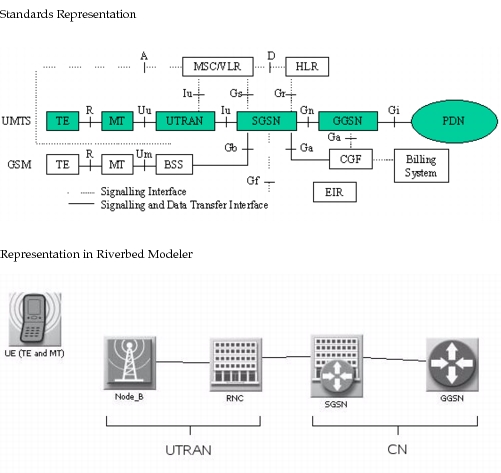
The UMTS model of the packet wireless network is based on 3rd Generation Partnership Project (3GPP) Release-5 standards. The network architecture of this release is divided into the radio access network (RAN) and the core network as shown in Figure 577. The UMTS module models the UMTS RAN and the UMTS functionality of the core network (see highlighted elements in Figure 577). The radio access network for UMTS contains the User Equipment (UE), which includes the Terminal Equipment (TE) and Mobile Terminal (MT), and the UMTS Terrestrial Radio Access Network (UTRAN), which includes the Node-B and Radio Network Controller (RNC).
UMTS uses Wideband Code Division Multiple Access (W-CDMA) access scheme. This version of W-CDMA uses direct spread with a chip rate of 3.84 Mcps and a nominal bandwidth of 5 MHz. The model supports one of W-CDMA's two duplex modes: Frequency Division Duplex (FDD). Time Division Duplex (TDD) is not supported. In FDD mode, uplink and downlink transmissions use different frequency bands. The radio frame has a length of 10 ms and is divided into 15 slots. Spreading factors vary from 256 to 4 for an FDD uplink and from 512 to 4 for an FDD downlink. With these spreading factors, data rates of up to 2 Mbps are attainable.
The packet domain core network includes two types of network nodes: serving GPRS support nodes (SGSNs) and the gateway GPRS support node (GGSN). The GPRS support nodes (GSNs) include all GPRS functionality needed to support GSM and UMTS packet services. SGSNs monitor user location and perform security functions and access control. The GGSN contains routing information for packet-switched (PS) attached users and provides interworking with external PS networks such as the packet data network (PDN). The model's CN nodes include both SGSN and GGSN functionality.
The circuit switched (CS) core network, which is not currently modeled, includes the mobile switching center/visitor location register (MSC/VLR). The MSC/VLR is used in the packet domain architecture to efficiently coordinate PS and CS services and functionality. The Home Location Register (HLR) contains GSM and UMTS subscriber information. The Charging Gateway Functionality (CGF) collects charging records from the SGSN(s) and GGSN. The Equipment Identity Register (EIR) stores information about user equipment identity. The HLR, CGF, and EIR are included in this description for completeness, but are not currently modeled.
Figure 577: Overview of Packet Domain Architecture