Model Architecture
The GPRS network architecture is shown in the following figure. This section describes the nodes shown in the following figure, including their process and node models.
Figure 581: UMTS Network Architecture
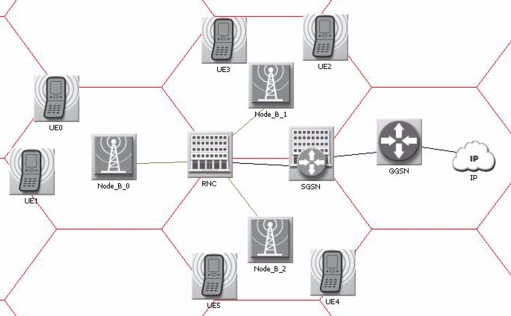
When a user powers-on, the model assumes that synchronization and a PS signalling connection are established. This PS signaling connection is kept for the entire simulation. Because of this, when a user powers-on it can immediately do a UMTS GPRS attach with the SGSN(s) to access to GPRS services.
Packets are queued when they are received from higher layers. Since each user supports four QoS profiles, the traffic is queued on one of four QoS queues. If no PDP context has been activated for that QoS profile, an Activate PDP Context Request is sent to the SGSN(s). This PDP context activation message includes the QoS requested. The model assumes that the SGSN(s), after consulting the RNC, either grants the QoS requested by the user in its entirety or rejects it. No negotiation by the SGSN/GGSN or RNC of the requested QoS is done at this stage.
On receipt of the Activate PDP Context Request, the SGSN(s) sends a RAB Assignment Request to the RNC along with the QoS requested. The UTRAN performs admission control to determine if the request can be granted. If the uplink and downlink have sufficient capacity to accommodate the request, the request can be granted. If the request can be granted, the RNC sends a Radio Bearer Setup request to the UE.
On receipt of the Radio Bearer Setup request, the UE sets up the channel as specified in the request and sends a Radio Bearer Complete to the RNC. On receipt of the Radio Bearer Complete, the RNC sends a RAB Assignment Response, which includes the granted QoS, to the SGSN/GGSN. The SGSN(s) then sends the Activate PDP Context Accept message, which also includes the granted QoS.
The UE can send packets to the destination on receipt of the Activate PDP Context Accept message from the SGSN(s). Before reaching their destination, these packets are first tunneled through serving the RNC and SGSN/GGSN, then routed through the IP cloud. If the destination network is also a UMTS network, then they are finally queued at the destination SGSN/GGSN node. Once a channel is set up at the destination, the packets are forwarded to the destination UE.