Inter-Domain MPLS Traffic Engineering
For discrete event simulation studies, LSPs cannot traverse multiple areas or autonomous systems. If you want to run simulations that include Cisco inter-area LSPs, Cisco inter-AS LSPs, or Juniper cross-connect circuits–based inter-area LSPs, you must use flow analysis.
Configuring Cisco Inter-Area LSPs
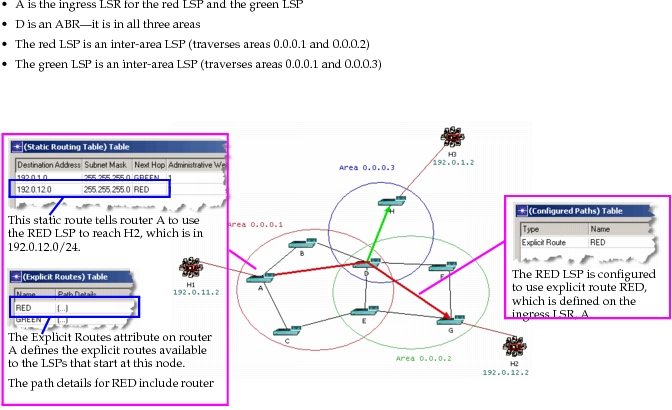
Inter-area LSPs are LSPs that traverse multiple areas in a network. To configure a Cisco inter-area LSP, you need to ensure the following:
- The explicit route of the LSP includes an area border router (ABR), which has interfaces in both areas traversed by the LSP. Explicit routes are configured in the MPLS > MPLS Parameters > Explicit Routes attribute on the ingress LSR.
- The ingress LSR includes a static route (or policy-based routing) to the egress LSR. This static route specifies the inter-area LSP as its next hop. Static routes are configured in the IP > IP Routing Parameters > Static Routing Tables attribute.
Figure 392: Cisco Inter-Area LSP Configuration
Configuring Cisco Inter-AS LSPs
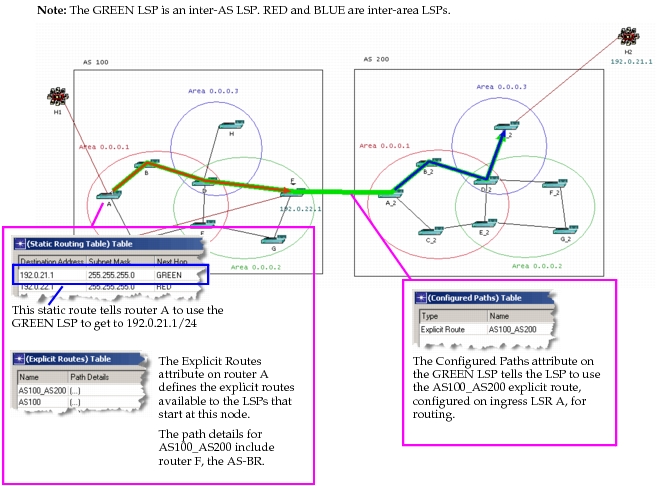
Inter-AS LSPs are LSPs that traverse multiple ASes in a network. They are supported on Cisco router models only. To configure inter-AS LSP, you need to ensure the following:
- The explicit route of the LSP includes an AS boundary router, which has interfaces in both ASes traversed by the LSP. Explicit routes are configured on the ingress LSR. Explicit routes are configured in the MPLS > MPLS Parameters > Explicit Routes attribute on the ingress LSR.
- The ingress LSR includes a static route (or policy-based routing) to the egress LSR. This static route specifies the inter-AS LSP as its next hop. Static routes are configured in the IP > IP Routing Parameters > Static Routing Tables attribute.
Figure 393: Inter-AS LSP Configuration
Configuring Cross-Connect Circuits (CCC)
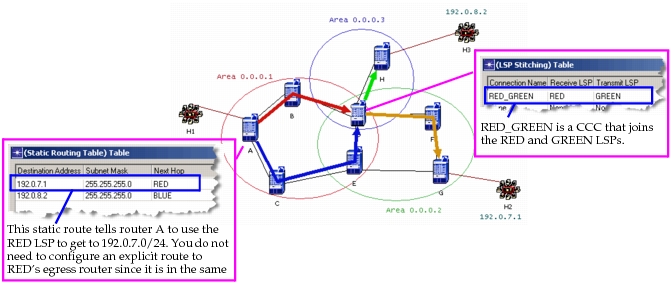
In Juniper networks, inter-area LSP routing is supported using cross-connect circuits (CCCs). CCCs use LSP stitching to combine two LSPs, where each LSP is entirely within a single area and the egress LSR of the first LSP is the ingress LSR of the second LSP. To configure CCCs, you need to ensure the following:
- On the ingress LSR of the second LSP, define a stitched LSP in the MPLS Parameters > Cross-Connects Parameters > LSP Stitching attribute. Specifies the first LSP as the Receive LSP and the second LSP as the Transmit LSP.
- The ingress LSR includes a static route (or policy-based routing) to the egress LSR. This static route specifies the inter-AS LSP as its next hop. Static routes are configured in the IP > IP Routing Parameters > Static Routing Tables attribute.
Figure 394: Cross-Connect Circuit Configuration