Finite Buffer Router Architecture
IP routers are modeled on a finite buffer architecture that operates in a slot-based processing mode or a central processing mode. In the slot-based processing mode, the IP module is composed of the following:
- A routing element
- One or more interface slot elements
- An interconnecting backplane
The routing element contains the routing process and memory to hold packets to be routed. Unprocessed packets are stored in a queue, then forwarded to the appropriate slot once processed.
Each interface slot element contains the following:
- One or more interfaces
- Memory to hold incoming and outgoing packets (either in a common shared RAM or in physically separate RAMs)
- A processor for local processing of packets
The backplane interconnector handles the transfer of packets between slots and the routing element.
Figure 213: Slot-based Processing Mode
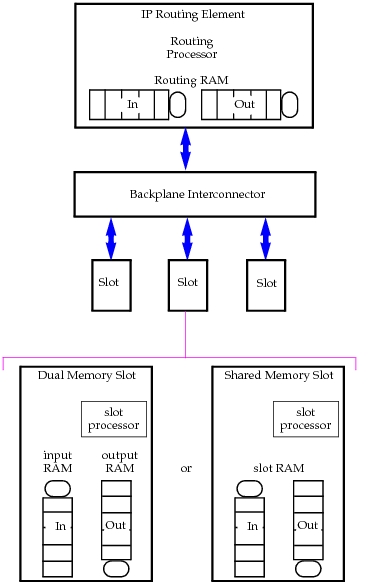
The central processing mode can be viewed as a degenerate version of the slot-based processing mode — it has no slots and network interfaces feed directly into and out of the routing queue.
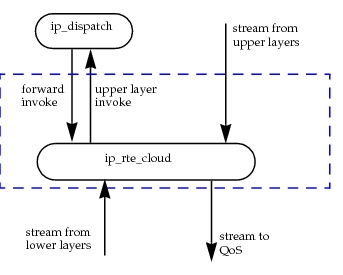
Each node intended to use IP has an IP routing module, which contains a dispatcher process that spawns the various routing processes. The three types of routing modules — centralized, slot-based, and cloud — are illustrated below.
Figure 214: Centralized IP Routing Module
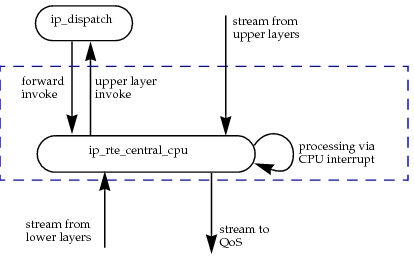
Figure 215: Slot-based IP Routing Module
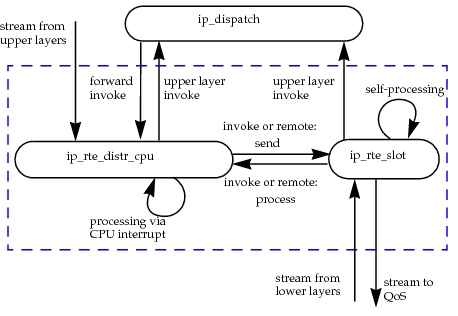
Figure 216: Cloud IP Routing Module
The following table lists the process models used by the IP model suite.
Table 110: IP Process Models
| Process Model | Description |
|---|---|
| ip_dispatch | Implements IP routing functions, and fragmentation and reassembly. IP packets arriving on any interface are routed to the appropriate output interface based on their destination address. The ip_dispatch process requires a fixed amount of time to route each packet. Packets are forwarded on a first-come, first-served basis. |
| ip_igmp_host | Implements the Internet Group Management Protocol (IGMP) in hosts. It is a child process of ip_dispatch. |
| ip_igmp_rte_grp | Implements IGMP in routers. The ip_igmp_rte_intf process spawns a child instance of this process for every multicast group in the subnetwork. |
| ip_igmp_rte_intf | Implements IGMP in routers (with ip_igmp_rte_grp). ip_dispatch spawns an instance of this process for each multicast-enabled interface on a router. |
| ip_icmp | Implements ICMP Echo Request/Response (ping) message generation and handling. This is a child process of ip_dispatch and is created once ip_dispatch configures its interfaces. |
| ip_pim_sm | Implements the Protocol Independent Multicasting - Sparse Mode (PIM-SM) multicast routing protocol in router nodes. This is a child process of ip_dispatch. |
| ip_output_iface | Implements queuing and dropping mechanisms. This is a child process of ip_dispatch. IP packets arriving on any IP output interface are sent to this process if the interface supports a queuing mechanism. This process model implements the following queuing mechanisms: FIFO (First in, First out), WFQ (Weighted Fair Queuing), Priority Queuing, Custom Queuing, etc. |
| ip_rte_central_cpu | This child process of ip_dispatch implements the centralized processing mode. |
| ip_rte_distrib_cpu | This child process of ip_dispatch implements the routing element in the slot-based processing mode. One instance of the ip_rte_slot process is spawned for each slot with active connections. |
| ip_rte_slot | This child process of ip_rte_distrib_cpu handles all traffic designated for a slot. |
| oms_basetraf_src | Handles background utilization traffic in routers. |