IP Addressing
An IP address is a 32-bit number consisting of two fields: the network number (identifying the network) and the host number (identifying a particular host within the network). An IP address is specified using dotted decimal notation. This notation uses four decimal integers separated by decimal points, where each integer is the value of one octet (8 bits) of the IP address. For example, the following 32-bit address:

Thus, an IP address is represented using the E.F.G.H format, where E, F, G, and H are decimal numbers between 0 and 255. Each of these decimal numbers represents one byte of the IP address. Together, the four bytes (32 bits) represent the network and host address. However, which numbers refer to the network and which numbers refer to the host depends upon the Internet address class. The following illustration highlights the most-commonly used address classes:
Figure 171: Internet Protocol Address Classes
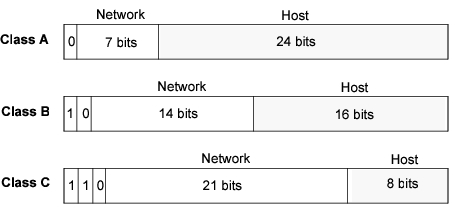
You can differentiate among the IP address classes by looking at the three most significant bits of the address. For example, the range of values for the first byte of Class C addresses begins at 192 (in decimal notation). The following table lists the range of values available as valid addresses for Class A, B, and C networks, based on the reservation of bits for network and host identifiers.
Table 99: Internet Protocol Address Range
| Class | Size (bytes) | Range of Values (dotted quad) | ||
|---|---|---|---|---|
| Network | Host | Network Portion | Host Portion | |
| A | 1 | 3 | 1 – 126 | 0.0.1 – 255.255.254 |
| B | 2 | 2 | 128.1 – 191.254 | 0.1 – 255.254 |
| C | 3 | 1 | 192.0.1 – 223.255.254 | 1 – 254 |
An integral part of IP addressing is subnet addressing (also called subnet routing or subnetting). Subnetting allows one IP network address to define and identify multiple underlying physical networks. This feature helps solve the potential problem of running out of the finite number of available IP network addresses. Subnet routing is achieved using extra bits from the host portion of the IP address. For example, consider a class B IP address: since it has 16 host number bits, it can assign 65536 node numbers. However, network configuration may require that nodes within this network are placed on different physical networks (for efficient administration, perhaps). If each physical network contains no more than 255 nodes, the higher order 8 bits of the host number portion of the IP address can be used for subnet addressing. Thus, the IP address representation changes from:
Figure 172: Internet Protocol Subnet Addressing
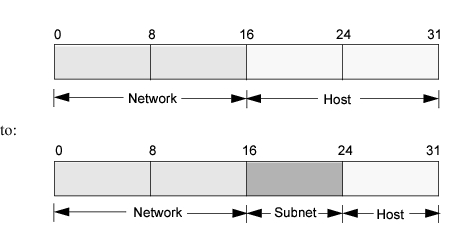
This representation allows a maximum of 256 physical networks, each with 255 nodes, to be addressed with the single IP address.
A subnet mask identifies how IP nodes interpret IP addresses. When configuring a subnet mask, the number of extra bits used as the subnet number is determined. Then, a value of 1 is set for every bit position in the IP address that will be recognized as part of the network or subnetwork number. Additionally, a value of 0 is set for every bit position in the IP address that should be recognized as the host identifier (or node number). For example, if the eight most significant bits from the host identifier field of a class B address are to be used as the subnet numbers, the resulting subnet mask will be 255.255.255.0. For more details on IP addressing or subnetting procedures, see any standard IP textbook, or to the Internet Engineering Task Force document RFC-950.