Segment-Based Trajectories
A segment-based trajectory consists of one or more points that define the mobile site’s movement and orientation along a three-dimensional path. Segment-based trajectories are stored in ASCII text files with a .trj extension and are assigned to a mobile node or subnet using the “trajectory” attribute.
During simulation, a mobile site follows its trajectory by moving in a great-circle path from one defined point to the next. A site’s position at a given time is determined by interpolating between the trajectory points immediately before and after that time. A segment-based trajectory specifies a mobile site’s location for a finite duration; if the simulation continues beyond the last specified time in the trajectory, the site remains at the trajectory’s end point.
Figure 6: Example Segment-Based Trajectory
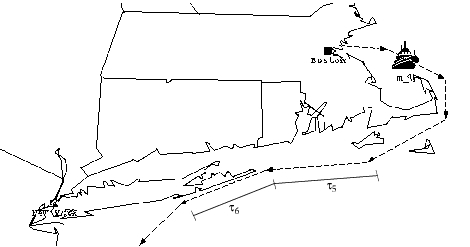
Each point of a segment-based trajectory has a specified x-y position, altitude, wait time, segment traversal time, and orientation (pitch, roll, and yaw). These values specify the site’s movement in the segment that ends at that point. For example, the wait time causes a mobile site to pause at the point before it begins traversing the next segment.
Note: The old fixed-interval format has been deprecated, but can still be read by network models. In this format, every point has the same traversal time and altitude. If you edit a fixed-interval format in any way, it is converted to the current variable-interval format.
There are three ways to define a segment-based trajectory:
- Graphically (see Defining Segment-Based Trajectories)
- In a text editor (see Segment-Based Trajectory File Format)
- Import from STK (see Importing STK Ephemeris Files)
Relative Movement in Segment-Based Trajectories
Because mobile sites can be nested (for example, a mobile node within a mobile subnetwork), the motion of the parent subnetwork can affect that of the child site. You must consider this when creating segment-based trajectories. The effect on motion is as follows:
- If the child site’s position units are degrees, movement is considered in an absolute sense relative to the earth. Parent subnetwork movement has no effect on the child site.
- If the child site’s position units are non-degree (such as meters or feet), movement is relative to the parent subnetwork. Thus, if the parent subnet is moving east at 10 feet per second (fps) and the child node within it is moving west at 5 fps, the motion of the node with respect to the earth is 5 fps east.
Options for Following a Segment-Based Trajectory
The definition of a segment-based trajectory includes two options that specify how a mobile site will follow the trajectory.
- Repeat – This option causes the site to follow the trajectory a specified number of times, or until the simulation ends. If the trajectory coordinates are relative to the site position, the site begins each repetition of the trajectory from the ending position of the previous repetition. If the trajectory coordinates are absolute, the site instantaneously jumps back to its original position and follows the same path again.
- Reverse – This option causes the site to follow the trajectory from beginning to end, wait a specified time (optional), and then retrace the trajectory back to the beginning position. When using both options, reverse paths are not included in the repeat count.
You can specify the repeat and reverse options in the Edit Trajectory Information dialog box. See Editing Segment-Based Trajectories for details.