Overview
Because radio links provide a broadcast medium, each transmission can potentially affect multiple receivers throughout the network model. In addition, for a given transmission, the radio link to each receiver can exhibit different behavior and timing. As a result, a separate pipeline must be executed for each eligible receiver. This section describes the purpose of each stage; the specific operation of the default stages is described in Default Models.
The Radio Transceiver Pipeline consists of fourteen stages, most of which must be executed on a per-receiver basis whenever a transmission occurs. However, stage 0 (receiver group) is invoked only once for each pair of transmitter and receiver channels in the network, to establish a static binding between each transmitter channel and the set of receiver channels that it is allowed to communicate with. Stage 1 (transmission delay) is used to compute a result that is common to all destinations, and therefore can be executed just once per transmission. Finally, each individual pipeline sequence might not fully complete, depending on the result of stage 2 (closure), because this stage is responsible for determining if communication between the transmitter and receiver is possible on a dynamic basis. Similarly, stage 3 (channel match) might classify a transmission as irrelevant with regard to its effect on a particular receiver channel, thereby preventing the pipeline sequence from reaching the final stages.
Note from the following diagram that several of the later stages of the Radio Transceiver Pipeline might be executed multiple times for each receiver, due to interactions with multiple concurrent transmissions from other sources. To detect concurrent reception of multiple packets at the same receiver channel, the Simulation Kernel maintains two lists of “current” packets for each radio receiver channel object. The first list contains only packets that have been determined to be valid by the channel match stage; the second list contains invalid packets. Valid packets are those that meet the criteria of the channel for proper reception. Generally, this requires that the transmitter and receiver channels have matching characteristics, and possibly also that the receiver channel be able to synchronize to the packet’s signal. The primary reason for maintaining invalid and valid packets in separate lists is that this allows the Simulation Kernel to execute certain pipeline stages or to compute certain channel statistics only for valid packets. For example, there is no need to calculate signal-to-noise ratio, bit error rate, or error allocations for packets that cannot be accepted by the receiver. In general, all of the stages following the received power stage are applicable only to valid packets.
Figure 85: Radio Transceiver Pipeline Execution Sequence for One Transmission
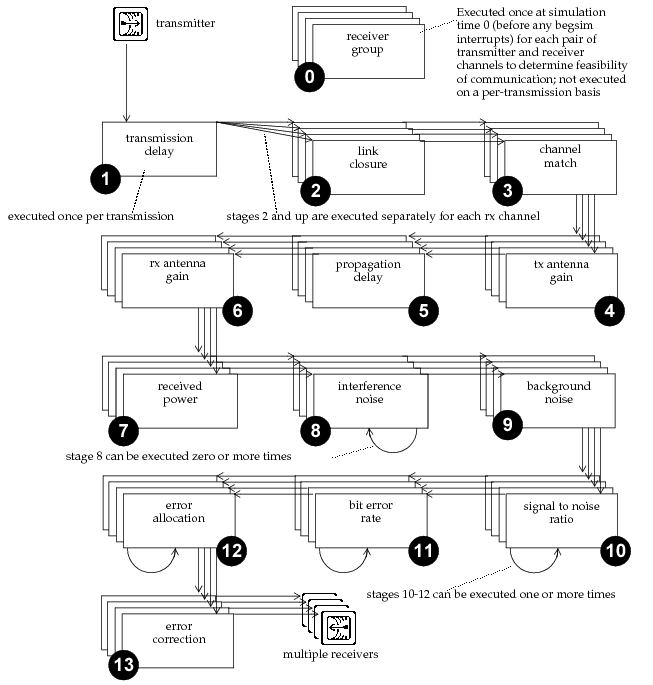
Stages 9 through 12 of the pipeline are invoked to evaluate a link’s performance in response to changes in the signal condition. There is always at least one invocation of stages 10 through 12 to evaluate performance over the full duration of a valid packet. However, an additional invocation will occur for each of these stages (9–12) whenever an interfering packet arrives, to compute new signal conditions.
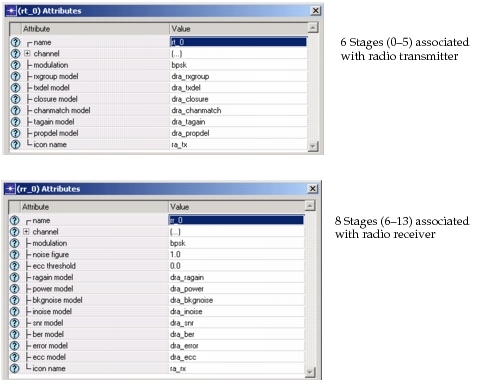
Because radio links do not exist as physical objects, the pipeline stages used to support a particular radio transmission must be associated with the radio transmitter and radio receiver that form the link. Certain stages are associated with the transmitter and others with the receiver, as shown in the following diagram. The default models used for each stage are described in Default Models.
Figure 86: Radio Transceiver Attributes for Specifying Pipeline Stages