Model Architecture: TCP
The following sections have more relevance to model developers (e.g., Modeler users). They discuss the topics necessary for understanding the internal details and interfacing to the TCP model. The following diagram shows the relevant portions of a typical node model where the TCP model resides.
Figure 559: Node Model with TCP
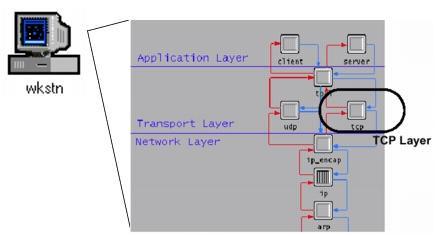
Each node intended to use TCP has a “tcp” module, which contains a dispatcher process that spawns connection processes:
Table 218: TCP Model Processes
| Process | Description |
|---|---|
tcp_manager_v3 |
Represents the root process of the “tcp” module. It manages a set of TCP connections by invoking the appropriate tcp_conn_v3 process to handle the arriving requests |
tcp_conn_v3 |
Represents the TCP connection (i.e., “socket”) process, which manages one end of a single connection. It is spawned by the tcp_manager_v3 process to manage activities related to an individual connection |
Each TCP connection (also called socket processes) is a structured information exchange between two connection processes. The following diagram illustrates the role of socket processes in the TCP model suite:
Figure 560: Socket Processes in the TCP Model
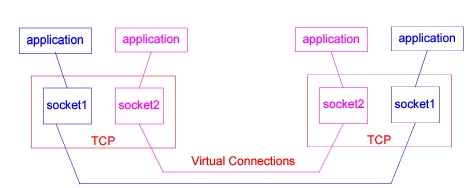
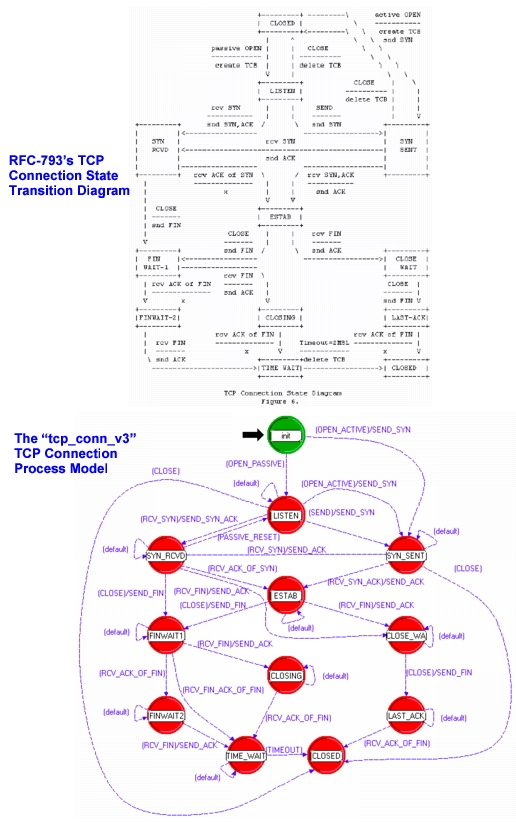
The socket processes are dynamically created and destroyed upon application requests. Each socket process (tcp_conn_v3) contains the core logic for various TCP protocol features. To illustrate the conformance to specified standards, note that the implementation of the TCP connection process in Riverbed Modeler exactly resembles the specification in RFC-793:
Figure 561: RFC-793 Specification Compared to the TCP Process Model
For more information, see: