Sending and Receiving Real Payload at the TCP Layer
When packets from one simulation need to be communicated to a remote simulation over real hardware, the model must segment payload to a real bit stream so that it can be reassembled on the receiving end. For this purpose, the TCP model can manage/store the payload as real bits using the oms_sar buffer package.
- On the transmitting node, packets are passed from the application layer into the transport layer, where the TCP model segments the data, using
oms_sar, and passes it to the lower layers. - On the receiving node, packets are passed from the lower layers to the transport layer, where they are reassembled by the TCP model, using
oms_sar, and made available to the application layer.
The oms_sar package engaged by the TCP model enables it to send and receive real-world payload (e.g., images, text) when sourced externally. This is in addition to the existing capability of exchanging simulated payload, which does not have content. Simulated payload sizes are relevant for studying network effects.
Two cases in particular benefit from this enhancement:
- Sending and Receiving Real Payload with System-in-the-Loop (SITL)
- Sending and Receiving Real Payload with High-Level Architecture (HLA)
Sending and Receiving Real Payload with System-in-the-Loop (SITL)
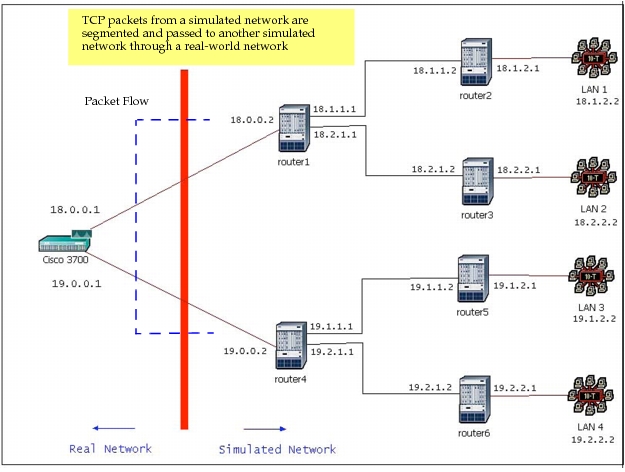
System-in-the-Loop (SITL) provides an interface between a simulated network running in Riverbed Modeler and a physical network. Packets traveling between the simulated and real networks are translated between real and simulation formats. With SITL, physical hardware and a simulation can interact as a unified system.
Note: SITL is optional functionality for Riverbed analysis software.
One possible configuration for SITL uses multiple gateways in the simulation to connect two simulated networks to external hardware, as shown in the following figure. Using this configuration, you can send simulated traffic from one part of a simulation through a real network (such as a physical router) and back to another part of the simulation. Such a configuration can be used either to test real hardware under different types of application loads or playback an application packet trace and study its dynamics when transmitted over real hardware. With oms_sar, SITL would just need to perform protocol header conversion on transmission and reception between networks (real or simulated).
Note: Conversion of BGP messages into real TCP payload is available, providing support of BGP over SITL. This allows BGP communication between a simulation and a real router. For more information, please see “Real BGP Payload Support in Simulations” on page 4.
Figure 553: SITL Use Case for TCP Real Payload
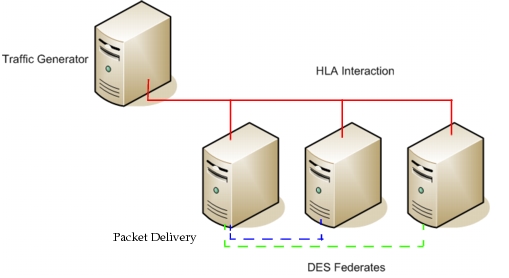
Sending and Receiving Real Payload with High-Level Architecture (HLA)
The High-Level Architecture (HLA) functionality in Riverbed Modeler lets you include a simulation as one of the federates in an HLA federation, and thus to both affect—and be affected by—events in other federates.
Note: HLA functionality is optional.
With oms_sar, and with HLA translation code in place, TCP connections can be established between Riverbed Modeler federates to exchange traffic.
Figure 554: HLA Use Case