Background Protocol Information
The following is a basic overview of the SRP and DPT technology. For detailed information, see Table 210.
DPT Background
Cisco’s Dynamic Packet Transport (DPT) products define a new generation of transport technology — packet optimized optical transport solutions. These solutions combine the bandwidth-efficient and service-rich capabilities of IP routing with the bandwidth-rich, self-healing capabilities of fiber rings to deliver fundamental cost and functionality advantages over existing solutions.
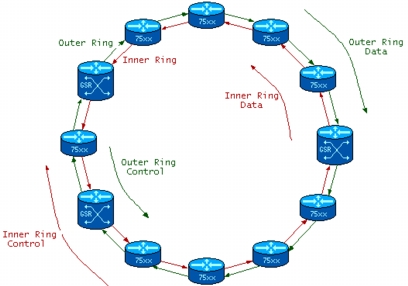
DPT uses a bi-directional, counter-rotating pair of fiber rings. This pair of rings consists of an inner ring and an outer ring, as shown in the following figure.
Figure 542: Outer and Inner Rings in DPT’s Fiber Rings
Spatial Reuse Protocol Background
DPT leverages a new MAC layer protocol, the Spatial Reuse Protocol (SRP). SRP derives its name from the protocol’s destination stripping operation. This operation differs from current ring technologies, such as Token Ring or FDDI, which use source stripping operations.
For example, in FDDI and Token Ring, packets circulate around the entire ring before they are removed by the source node. In SRP, the destination node strips packets from the ring, permitting other packets to use the full bandwidth on other segments of the ring. Because each ring node can source packets onto the ring concurrently, this provides a major opportunity to maximize ring bandwidth.
In particular, SRP has the following features:
- efficient bandwidth usage due to:
- spatial reuse of bandwidth
- local reuse of bandwidth
- minimal protocol overhead
- support for priority traffic
- scalability across a large number of nodes or stations attached to a ring
- fairness among nodes using the ring
- support for ring-based redundancy (error detection, ring wrap, and so on)
SRP uses control information to handle tasks such as keep-alive messages, bandwidth control propagation, and protection switching. SRP utilizes both explicit control packets and piggy-backed control information within data packets to share control information.
DPT operates by sending data packets in the one direction (downstream, for example) and by sending the corresponding control packets in the opposite direction (upstream in our example) on the other fiber. DPT, therefore, uses both fibers concurrently to maximize bandwidth for packet transport and to accelerate control signal propagation for adaptive bandwidth utilization and for self-healing purposes.
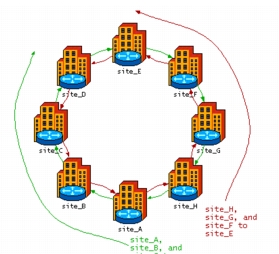
As a benefit of spatial reuse, consider the following example. In an aggregation application where the traffic flows are largely between routers site_A, site_B, site_C and site_D and separately between routers site_H, site_G, site_F and site_E, spatial reuse can easily provide a (x2) bandwidth multiplier.
Figure 543: Illustration of Spatial Reuse