Model Attributes
Each node with SRP as one of its contained protocols provides an attribute called SRP Parameters that is used to specify SRP configuration parameters.
Figure 535: SRP Parameters Attribute on the srp_station Node Model
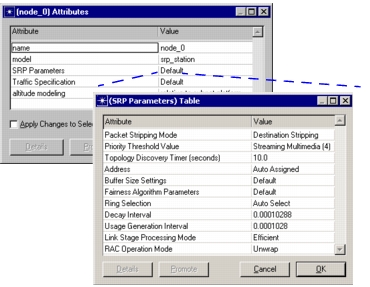
The SRP Parameters attribute itself consists of many sub-attributes. These sub-attributes can be viewed and modified by selecting Edit… from the SRP Parameters pull-down menu. Some of the important SRP model attributes are:
- Packet Stripping Mode. This attribute specifies the mode used when packets are stripped from the DPT rings. The default mode differs according to the type of packet: Destination Stripping for unicast packets, and Source Stripping for multicast packets.
- Priority Threshold Value. This attribute specifies the threshold value for mapping IP type of service (ToS) to SRP priority level. IP TOS has eight levels and SRP maps each of these eight levels to one of its two levels (high or low). Higher layer packets with a ToS assignment that is lower than this threshold are assigned low priority, while those with a ToS assignment that is higher than this threshold are assigned high priority.
- Topology Discovery Timer: This attribute specifies the time (in seconds) between successive topology discovery packets sent out by the node. The default value of this timer is 10 seconds. This attribute, along with the SRP Topology Discovery Stop Time simulation attribute, controls how the Topology Discovery feature is modeled.
- Address: This attribute specifies the address of the SRP MAC protocol entity. When set to Auto Assigned, the model automatically assigns MAC addresses during a simulation. To explicitly set the station_address attribute, specify an integer value that is unique across all MACs in the network.
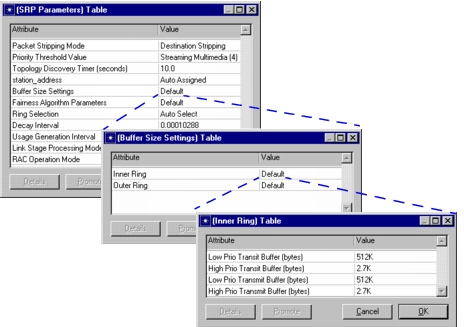
- Buffer Size Settings: This attribute specifies buffer capacities for inner and outer ring transit and transmit buffers for low- and high-priority packets.
Figure 536: Specifying the Buffer Size Settings Attribute
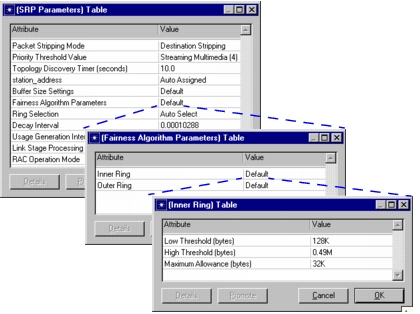
- Fairness Algorithm Parameters: This attribute specifies the parameters that are used by SRP's fairness algorithm for each ring.
- Low Threshold: This attribute specifies the transit buffer depth at which no low-priority host packets can be sent.
- High Threshold: This attribute specifies the transit buffer depth at which no high-priority host packets can be sent.
- Maximum Allowance: This attribute specifies the maximum amount of low-priority traffic that the node can place on the ring. It models the SRP fairness algorithm’s MAX_ALLOWANCE or MAX_USAGE parameter.
Figure 537: Specifying the Fairness Algorithm Parameters
- Ring Selection: This attribute specifies which ring, inner or outer, is used for transmitting the data sourced (put onto the ring) by this node. The default value for this attribute, Auto Select, uses the SRP ring selection algorithm to select one of the rings. This attribute does not affect transit data passing through this node — transit data is forwarded onto the same ring it arrived on.
- Decay Interval: This attribute specifies the SRP-fa decay timer. The default value of 0.00010288 is based on the transmission time of 8 Kbytes with DPT-OC12 or 32 Kbytes with DPT-OC48.
- Usage Generation Interval: This attribute specifies the usage packet generation timer. This timer alerts the SRP MAC to send a usage packet to its upstream neighbor. Generally, this attribute is set to a value less than the decay interval.
- Link Stage Processing Mode: This attribute specifies whether or not the DPT link stage events are modeled during a simulation. Link stage events are modeled in the Explicit mode, but are not modeled in the Efficient mode. When the Efficient mode is used, no utilization or throughput statistics can be collected.
- RAC Operation Mode: This attribute specifies if the “wrap” mode is enabled on this node. When set to Wrap, the wrap mode is enabled and the SRP MAC can study the performance of the SRP-fa under ring wrap situations.