VLAN Parameters Attribute
The VLAN Parameters attribute on the switch specifies the VLANs supported by the node. The related attribute tables are shown below:
Figure 626: VLAN Parameters Sub-attributes
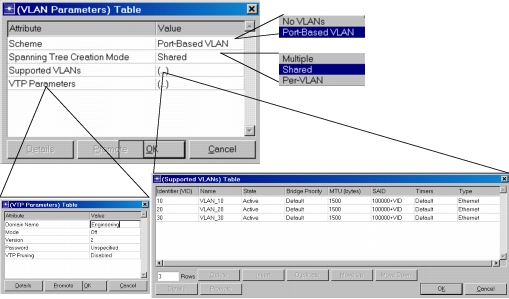
The VLAN Parameters attribute has only one row that consists of the following sub-attributes:
- Scheme. This should be set to Port-Based VLAN to configure a VLAN. The alternative setting is No VLANs.
- Supported VLANs. This compound attribute enables you to define all the VLANs supported by this switch. Create a row for each supported VLAN. If you used the Configure VLANs for Selected Nodes command in the Protocols menu (described above), Riverbed Modeler created one row in the Supported VLANs table for each VLAN you specified. By default, a VLAN-aware node supports one VLAN with VID 1.
The Supported VLANs attribute contains the following sub-attributes:
- Identifier (VID). A VLAN ID consisting of an integer between 1 and 4094. Each VLAN needs a unique VID. The VLAN with the VID of 1 is considered the default VLAN.
- Name. A name for the supported VLAN.
- State. (Not currently used.)
- MTU (bytes). (Not currently used.)
- SAID. Represents the security association identified (SAID) for this VLAN. Default setting is 100,000 plus the VLAN identifier. Note that this attribute currently has no effect on simulation performance.
- Timers. Timers used for setting up and maintaining spanning tree for this VLAN. By default, they inherit the setting from the Bridge Parameters attribute. Note that this attribute is not currently used.
- Bridge Priority. Timers used for setting up and maintaining spanning tree for this VLAN. By default, they inherit the setting from the Bridge Parameters attribute. Note that this attribute is not currently used.
- Spanning Tree Creation Mode. This attribute is used only by VLAN-aware bridge/switch nodes. The value of the attribute affects two processes:
- The creation of the spanning tree in the bridged network
- The filtering database learning mode used by the surrounding node
- When the value is set to “Shared” the spanning tree algorithm creates a single tree over the bridged network that is then used by all existing VLANs, and the node will perform shared VLAN learning (SVL). This means any MAC address learned by a VLAN is entered into the filtering database without VLAN information, so these entries will be used also by all other VLANs supported on the same node.
- If the value is set to “Multiple” then the node will run Multiple Spanning Tree Protocol (MSTP, IEEE 802.1s) as its spanning tree protocol, which also requires the attribute “Bridge Configuration > Spanning Tree Protocol” to be set to “RSTP (802.1w).” The node will create and maintain a separate spanning tree instance for each VLAN it supports. The traffic of each VLAN is then forwarded based on the topology of the spanning tree to which that VLAN is mapped. The node will perform Independent VLAN Learning (IVL) as the filtering database learning mode. This means any MAC address learned in one VLAN will be entered into the filtering database with VLAN information, which will make this entry usable only by that VLAN (i.e., all VLANs will have their individual entries in the database for the MAC addresses).
- If the value is set to “Per-VLAN”, the node will perform IVL for database learning. With this setting, it will model the PVSTP, which is a CISCO proprietary protocol. Under this configuration, a separate bridge protocol entity will be spawned for each supported VLAN, which will follow the rules of 802.1D protocol and form VLAN specific spanning trees with its PVSTP running neighbors. To be able to use this tree creation mode, the attribute “Bridge Configuration > Spanning Tree Protocol” has to be set to “STP (802.1D).”
- VTP Parameters—(not used in simulations) VLAN Trunking Protocol (VTP) is a Cisco Layer-2 messaging protocol that maintains VLAN configuration consistency by managing the addition, deletion, and renaming of VLANs on a network-wide basis. The range of vlans VTP can manage is Vlan 1 to Vlan 1005.