Model Interfaces
The following sections describe components of the Cyber Effects model.
Cyber-Effects Manager Module
Node models that support cyber modeling must contain a cyber-effects manager (CEM) module. This module connects via UDP and is used to process effects scripts and manage the node’s response to cyber events. It carries the cyber effects attributes that are promoted to the node level (as described in Node Attributes).
The CEM module knows which effects are supported by the other modules in its node. It controls the timing and conditional execution of effects by sending commands to modules and receiving responses from them as required by the scripts it runs. These scripts can be locally configured or received from other nodes. The CEM is also in charge of starting any attack or remedy profiles configured in the node and sending the scripts indicated in the profiles to the specified destinations.
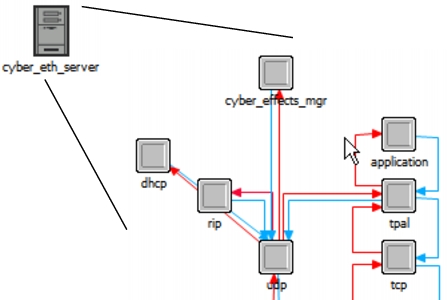
The following figure illustrates the relevant portions of a typical node model where the cyber-effects manager module resides.
Figure 124: Placement of Cyber-Effects Manager Module in the cyber_ethernet_server Node Model
The following table summarizes the process models used by the cyber-effects manager module.
Table 35: cyber_effects_mgr Process Models
| cyber_effects_mgr | Used by the cyber_effects_mgr (CEM) module. The CEM adds support for cyber effects to the containing node, letting you specify attacks, remedies, and scripts for the node. It communicates with other cyber-enabled nodes, manages attack and remedy profiles, executes scripts, and manages the execution of cyber effects on the node. |
| instructions_mgr | Child process spawned by cyber_effects_mgr. This process executes the attack or remedy profiles set in the node, as well as scripts set in the node or received via packet from another node. One process is spawned for each profile and script to be executed. The process is destroyed after the profile or script is fully executed. |
| cyber_effects_source | Child process spawned by cyber_effects_mgr to generate traffic. This process is used to model the “Generate Traffic to…” effect of the General effects category. |
Packet Formats
The Cyber Effects model uses the following packet formats.
Table 36: Cyber Effects Packet Formats
| Packet Format | Description |
|---|---|
| cyber_effects_msg | Used to carry a single script to one intended destination. |
| cyber_effects_resp | Used to respond to a “return infect confirmation” effect. It carries the infection status of the sender node. |