Riverbed-Provided Ovis Mapping Library
The following sections describe the input used by the Riverbed-provided library.
Attribute-Based Mapping
The default Ovis library uses one compound attribute with a predefined name and definition. The model developer simply needs to add this attribute to a node model or a site instance as extended attributes. The 3DNV attribute is shown in the following figure.
Figure 7: 3DNV Attribute
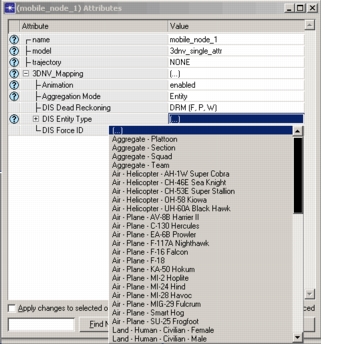
3DNV Mapping
- Attribute name: “3DNV Mapping”
- Public attribute definition: 3DNV_Mapping
- Type: Compound
Sub-Attribute “Animation”
- Type: Toggle
- Description: This field indicates if the site should appear as a 3D object in 3D Network Visualizer based on the other attributes. This allows it to toggle the display without losing the other settings.
Sub-Attribute “Aggregation Mode”
- Type: Enumerated with two symbols
- Description: This field indicates the type of 3D object to display, namely an entity (detected 3D model) or an aggregate (simpler representation).
Sub-Attribute “DIS Entity Type”
- Type: Compound
- Description: The attribute name is “DIS Entity Type”. Based on IEEE 1278.1-995 (http://www.sisostds.org/dis-dd/pdu/28.htm), it is a 1-row compound of 7 integers.
Kind
- Size: 8
- Data Type: Enumerated
- Description: This field identifies the kind of entity.
Table 4: Entity Kind Attribute Values
| Value | Description |
|---|---|
| 0 | Other |
| 1 | Platform |
| 2 | Munition |
| 3 | Life form |
| 4 | Environmental |
| 5 | Cultural feature |
| 6 | Supply |
| 7 | Radio |
| 8 | Expendable |
| 9 | Sensor/Emitter |
Domain
- Size: 8
- Data Type: Enumerated
- Description: This field shall specify the domain in which the equipment operates (subsurface, surface, land, etc.) except for munition entities. For Munition entities this field shall specify the domain of the target (for example, the munition might be surface-to-air, so the domain would be anti-air).
Country
- Size: 16
- Data Type: Enumerated
- Description: This field shall specify the country to which the design of the entity is attributed. This field shall be represented by a 16-bit enumeration. Values for this field are defined in Section 4 in EBV-DOC.
Category
- Size: 8
- Data Type: Enumerated
- Description: This field shall specify the main category that describes the entity. The enumerations of category depend upon both the Kind and Domain. In Riverbed terms, this means that we might want to provide some active attribute library to tailor the appropriate values based on the Kind and Domain.
Subcategory
- Size: 8
- Data Type: Enumerated
- Description: This field shall specify a particular subcategory to which the entity belongs based on the category and the country. In Riverbed terms, this means that we might want to provide some active attribute library to tailor the appropriate values based on the Category and Country.
Specific
- Size: 8
- Data Type: Enumerated
- Description: This field shall specify specific information about an entity based upon the subcategory field to which it belongs.
Extra
- Size: 8
- Data Type: Enumerated
- Description: This field shall specify extra information required to describe a particular entity. The contents of this field shall depend on the type of entity represented.
Sub-Attribute “DIS Force ID”
- Type: Integer with 4 possible values/symbols.
- Size: 8
- Data Type: Enumerated
- Description: This field shall distinguish the different teams or sides in a DIS exercise.
Table 5: DIS Force ID Attribute Values
| Value | Description |
|---|---|
| 0 | Other |
| 1 | Friendly |
| 2 | Opposing |
| 3 | Neutral |
Sub-Attribute “DIS Dead Reckoning”
- Type: integer with 10 possible values/symbols.
- Size: 8
- Data Type: Enumerated
- Description: Indicates the type of dead reckoning algorithm used by an entity.
Table 6: DIS Dead Reckoning Attribute Values
| Value | Description | Definition |
|---|---|---|
| 0 | Other | Fixed—does nothing |
| 1 | Static (entity does not move) | Fixed—does nothing |
| 2 | DRM(F, P, W) | Fixed—constant velocity |
| 3 | DRM(R, P, W) | Rotational—constant velocity |
| 4 | DRM(R, V, W) | Rotational—constant acceleration |
| 5 | DRM(F, V, W) | Fixed—constant acceleration |
| 6 | DRM(F, P, B) | Fixed—unimplemented |
| 7 | DRM(R, P, B) | Rotational—unimplemented |
| 8 | DRM(R, V, B) | Rotational—unimplemented |
| 9 | DRM(F, V, B) | Fixed—unimplemented |
The default mapping library implements the following callbacks:
-
load—check the initialization string from the 3dnv.mapping_argument preference. The following options are currently supported:
- -verbose: Displays a message at each invocation of a mapping callback, similar to a trace output in ODB
- -hierarchical_names: If this option is used, the Ovis entities will use the full hierarchical name. Otherwise the name is simply the name of the mapped object.
-
enable—Traverse the network topology looking for subnets and nodes that have an attribute named 3DNV Mapping with the expected structure. For every subnet and node with this attribute, the mapping library creates a corresponding Ovis entity based on the attribute value. Any node with a “node-level” mapping callback will have this callback invoked instead of the library's default node enabling code.
After the library implements these callbacks, it looks for point-to-point links between mapped nodes and creates corresponding Ovis 3D Line decorations between the related Ovis entities.
-
attribute change—Check the 3DNV Mapping attribute value and create/update/destroy the corresponding Ovis entity based on the attribute values. This also creates or destroys 3D line decorations that represent the point-to-point link topology between mapped nodes. Any node with a 'node-level' mapping callback will have this callback invoked instead of the library's default node enabling code.
-
disable—Check for a “node-level” callback function and invoke it if present. The 3D Network Visualizer library automatically destroys the unmapped 3D entities and any 3D decorations attached to these entities.
-
unload—Print a message reporting the callback being invoked if the initialization string included the -verbose option