Animation Pipeline
Infrastructure
Riverbed analysis software decouples the modeling part of packet transmission pipelines from the animation part by providing a separate framework that associates animation callbacks with the various stages of a wireless communication based on the TDAs values. This ensures that the same animation can be used with various pipeline stage models.
Communication animations are defined through a set of callbacks specified by process model code. You can have several such animations in a simulation.
Data Structures
The simulation kernel maintains a set of data structures with the wireless modules and communications associated with probed nodes. These are opaque, but they include a model-specific state component, to be defined and allocated by appropriate callbacks. For information about the procedures used to access these objects, see Communication Sub-Package.
Table 7: Data Structures for Wireless Objects
| Data Structure | Description |
|---|---|
OvisT_Transmitter |
Associated with a transmitter channel of a mapped site. A single channel can have multiple associated OvisT_Transmitter objects that correspond to different animations. |
OvisT_Receiver |
Associated with a receiver channel of a mapped site if that channel is part of the receiver group of a mapped transmitter (or connected to a mapped transmitter by a wireline link). |
OvisT_Transmission |
Represents a packet transmission between a transmitter and a set of receivers. Created by the kernel for each Ovis transmitter at the start of transmission, and destroyed once all receptions have been completed. |
OvisT_Reception |
Represent a potential packet reception. Created by the kernel for each Ovis transmission object and each Ovis receiver object at the receiver node, and destroyed by the kernel once the reception is over. Note: For point-to-point communications, the number of OvisT_Receptions is the same as the number of transmissions. |
Callbacks
In the following, X_ means radio_, bus_, or link_ for the 3 kinds of communication medium. This means that three different entry points can be defined.
State Management
The various _destroy callbacks will be invoked when the simulation ends to allow for cleanup of the animation space.
Transmitter
The OvisT_Transmitter data structure is dynamically created and associated with the transmitter channel by the APIs Ovis_Wireless_Transmitter_Animation_Enable(), Ovis_Bus_Transmitter_Animation_Enable(), or Ovis_Ptpt_Link_Transmitter_Animation_Enable(). Which API is used depends on the transmitter channel type. As a result of such a call, the OvisT_Transmitter data structure with a specified set of transmission event-handling callbacks will only be created for channels that belong to nodes that are mapped to Ovis entities. Note that there may be multiple OvisT_Transmitter structures with different sets of callbacks associated with each transmitter channel objects.
Table 8: Transmitter Callbacks
| Callback | Reference |
|---|---|
X_transmitter_init |
OvisT_Anim_Transmitter_Init_Proc |
X_transmitter_destroy |
OvisT_Anim_Transmitter_Destroy_Proc |
Receiver
The simulation kernel automatically creates the OvisT_Receiver data structure. The kernel adds a receiver channel object to transceiver reception groups (or to receivers connected to transmitters by wireline links) that have one of the following conditions:
- The transceiver has an associated
OvisT_Transmitterdata entry. - Entries with one
OvisT_Receiverthat is associated with a receiver channel. This particular receiver channel is created for eachOvisT_Transmitterthat is associated with the transmitter channel.
Only one instance of OvisT_Receiver is created for a given set of transmission callback and if the receiver channel belongs to receiver groups of multiple transmitters, the same OvisT_Receiver structure is shared.
Table 9: Receiver Callbacks
| Callback | Reference |
|---|---|
X_receiver_init |
OvisT_Anim_Receiver_Init_Proc |
X_receiver_destroy |
OvisT_Anim_Receiver_Destroy_Proc |
Transmission
The OvisT_Transmission data structure is created by the kernel when a transmission is initiated by a transmitter in a mapped object.
The structure is destroyed after all the associated receptions have been destroyed.
Table 10: Transmission Callbacks
| Callback | Reference |
|---|---|
X_transmission_init (Called before any invocation of PS in start transmission event) |
OvisT_Anim_Transmission_Init_Proc |
X_transmission_destroy (Called after all associated receptions have been received) |
OvisT_Anim_Transmission_Destroy_Proc |
Reception
The OvisT_Reception data structure is created by the kernel before the link closure pipeline stage for a transmitter/receiver pair. The structure is destroyed once the reception is complete (successfully or not). This combination of create/destroy callbacks allows animation of failed transmissions, for which transmission start and end may never be called.
Table 11: Reception Callbacks
| Callback | Reference |
|---|---|
X_reception_init (Called before any invocation of receiver-related PS in start transmission) |
OvisT_Anim_Reception_Init_Proc |
X_reception_destroy (Called after reception has been completed) |
OvisT_Anim_Reception_Destroy_Proc |
Communication Steps
Receiver Group
The receiver group is created during the post-init stage for wireless transmitters. It can then be modified by various KPs.
Table 12: Receiver Group Callbacks
| Callback | Reference |
|---|---|
wireless_rxgroup_preset |
Called before setting a receiver group to a set, using op_radio_txch_rxgroup_set() or op_radio_txch_rxgroup_compute() See OvisT_Anim_Wireless_Rxgroup_Pre_Set_Proc |
wireless_rxgroup_postset |
Called after setting a receiver group to a new set, during the postinit, or using op_radio_txch_rxgroup_set() or op_radio_txch_rxgroup_compute() See OvisT_Anim_Wireless_Rxgroup_Post_Set_Proc |
wireless_rxgroup_increase |
Called after op_radio_txch_rxch_add() See OvisT_Anim_Wireless_Rxgroup_Increase_Proc |
wireless_rxgroup_decrease |
Called after op_radio_txch_rxch_remove() See OvisT_Anim_Wireless_Rxgroup_Decrease_Proc |
Start Transmission
This corresponds to the various stages of a start transmission event.
Table 13: Start Transmission Callbacks
| Callback | Reference |
|---|---|
X_transmission_start |
Called after txdel Pipeline Stage See OvisT_Anim_Transmission_Start_Proc |
radio_broadcast, bus_broadcast |
Called after all receiver related Pipeline Stage invocations See OvisT_Anim_Bus_Broadcast_Proc and OvisT_Anim_Wireless_Broadcast_Proc |
End Transmission
This is invoked when the end transmission event is executed (txdel seconds after the start transmission).
Table 14: End Transmission Callbacks
| Callback | Reference |
|---|---|
X_transmission_end |
OvisT_Anim_Transmission_End_Proc |
Start Reception
This corresponds to the various stages of a start reception event.
Table 15: Start Reception Callbacks
| Callback | Reference |
|---|---|
X_reception_start |
Called after all PS invocations in Start Reception event See OvisT_Anim_Reception_Start_Proc |
End Reception
This is specific to the reception. Some of the interference callbacks are also involved (ber, snr, error).
Table 16: End Reception Callbacks
| Callback | Reference |
|---|---|
X_reception_end |
Called after all PS invocations in End Reception event See OvisT_Anim_Reception_End_Proc |
Execution Sequence
Point to Point Links
Start Transmission Event:
link_transmission_init()- Txdel pipeline stage
link_transmission_start()link_reception_init()- Propdel pipeline stage
End Transmission Event:
link_transmission_end()
Note: The transmission object is not destroyed until the reception is over.
Start Reception Event:
link_reception_start()
End Reception Event:
- Error Ecc pipeline stages
link_reception_end()link_reception_destroy (<End_Success> or <End_Failure>)link_transmission_destroy()
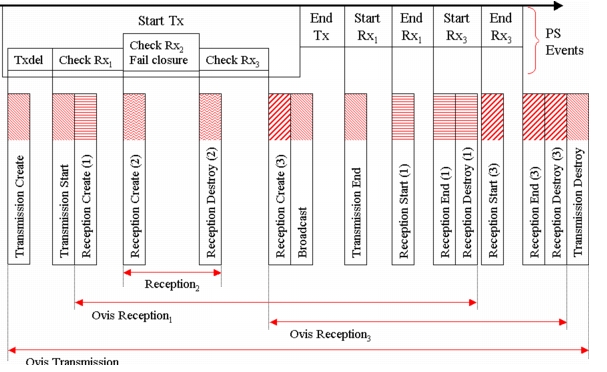
Wireless
Start Transmission Event:
wireless_transmission_init()- Txdel pipeline stage
wireless_transmission_start()- for all receivers in receiver group:
- Copy source packet
wireless_reception_init()- Closure Pipeline Stage
- If failed,
wireless_reception_destroy(Closure) - else
- Chanmatch Pipeline State
- If failed,
wireless_reception_destroy(Chanmatch) - else
- Txgain, Propdel pipeline stages
wireless_broadcast()
End Transmission Event: wireless_transmission_end
Note: The transmission object is not destroyed until all receptions are over.
Start Reception Event:
- Rxdel, Power pipelines stages
- If packet rejected at power:
wireless_reception_destroy(Power)
- else
- Inoise, Bgnoise, SNR pipeline stages
wireless_reception_start()
- If packet rejected at power:
End Reception Event:
- BER, Error, Ecc pipeline stages
wireless_reception_end()wireless_reception_destroy(End_Success or End_Failure)
After all receptions are over: wireless_transmission_destroy()
Bus
Start Transmission Event:
bus_transmission_init()- Txdel pipeline stage
bus_transmission_start()- For all receivers attached to the bus:
- Copy source packet
bus_reception_init()- Closure pipeline stage
- If receiver rejected
bus_reception_destroy(Closure)
- else
- Propdel pipeline stage
- If receiver rejected
bus_broadcast()
End transmission event: bus_transmission_end()
Note: The transmission object is not destroyed until all receptions are over.
Start Reception Event:
- collision pipeline state
bus_reception_start()
End Reception Event:
- Error and Ecc pipeline stages
bus_reception_end()bus_reception_destroy(End_Success or End_Failure)
After all receptions are over:
bus_transmission_destroy()
Figure 8: Callback Invocations During a Wireless Transmission: Example