Model Architecture
AODV
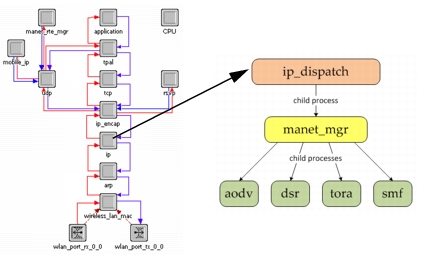
AODV is implemented at the IP layer. As shown in Figure 383, ip_dispatch is the root process for IP and has manet.mgr as a child process. manet_mgr acts as manager process for AODV and provides a common interface to multiple MANET routing protocols (AODV, DSR, TORA, and SMF). manet_mgr is responsible for spawning the AODV child process when a node is configured for AODV.
Figure 383: Node Model Structure Surrounding MANET
Process Model
The AODV model uses the following process models.
Table 155: AODV Process Models
| Process | Description |
|---|---|
manet_mgr |
Main dispatcher process that spawns the appropriate ad hoc routing protocol running on the node. It resides in the IP module as a child process of the ip_dispatch process. |
aodv_rte |
This AODV routing process is a child to the manet_mgr process. If AODV is configured on the node, the aodv_rte process is spawned by the manet_mgr to run AODV on the node. |
Packet Formats
An AODV packet can have the following options.
Table 156: Options for AODV Packets
| Option | Description |
|---|---|
AodvT_Rreq |
Route Request option. AODV route request option contains various flags: join flag, repair flag, gratuitous RREP flag, destination only flag, and unknown sequence number flag. Route request also includes the fields for hop count, route request ID, Destination and Source IP address, and sequence numbers. |
AodvT_Rrep |
Route Reply option. AODV route reply includes fields for Destination IP address and sequence number, Originator's IP address, lifetime of RREP, repair and acknowledgement required flag. |
AodvT_Rerr |
Route Error option. AODV Route Error option contains a list of unreachable destination addresses, each with its corresponding sequence number, number of unreachable nodes, and “no delete” flag. |
Timers
The AODV model includes the following timers.
Table 157: AODV Timers
| Timer | Description |
|---|---|
| Route Entry Expiry | Each route in an AODV route table is associated with a route expiry timer. If a route is not used within its expiry time, it is marked invalid and cannot be used to forward packets. A route is deleted after DELETE_TIME seconds. The expiry timer is refreshed every time a route is used. |
| Route Request Expiry | AODV associates a route request expiry timer with each Route Request sent. If no route reply is received within this time, another route request is sent out if the node hasn't reached its retry limit, otherwise all buffered packets for that destination are dropped. |
Table 158: DSR Process Models
| Process | Description |
|---|---|
manet_mgr |
Main dispatcher process that spawns the appropriate ad hoc routing protocol running on the node. It resides in the IP module as a child process of the ip_dispatch process. |
dsr_rte |
This DSR routing process is a child to the manet_mgr process. If DSR is configured on the node, the dsr_rte process is spawned by the manet_mgr to run DSR on the node. |
Packet Formats
Table 159: DSR Packet Formats
| Name | Description |
|---|---|
dsr |
This is the main DSR packet that is in the TLV (type, length, value) format. It is used for all the DSR options including route requests, route replies, acknowledgement requests, acknowledgements and source routes. The application packet is embedded in the DSR packet which in turn is embedded in an IP datagram. |
You can refer to the descriptions provided for each packet field to get more details about their importance.
ICI formats
There are no specific ICIs required to interface with the IP model. However, the DSR model uses an ICI to transfer DSR routing information to the IP CPU process.
Table 160: DSR ICI Formats
| Name | Description |
|---|---|
dsr_req |
This ICI is used to send the next hop address, as determined by DSR, to the IP process to be sent out on the appropriate interface. |
OLSR
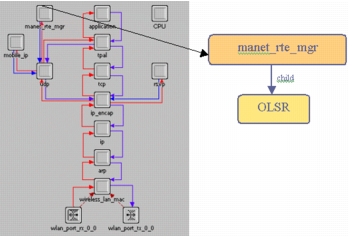
A root process, manet_rte_mgr, resides over UDP. OLSR is the child process of this manet_rte_mgr root process and communicates with UDP using port number 698 (as specified in the RFC). Packets coming from lower layers are passed to manet_rte_mgr by UDP, which in turn hands them to the OLSR child process. Control packets (Hello and TC messages) are sent out directly to UDP at the specified port by the OLSR child process. The following figure shows this architecture.
Figure 384: Node Model Structure Surrounding OSLR
Process Models
The OLSR model uses the process models listed in the following table.
Table 161: OLSR Process Models
| Process | Description |
|---|---|
manet_rte_mgr |
Root process that spawns the OLSR routing protocol running on a node. It resides above the UDP module. |
olsr_rte |
OLSR routing process is a child of the manet_rte_mgr process. If OLSR is configured on the node, the olsr_rte process is spawned by the manet_rte_mgr to run OLSR on the node. |
Model Internals
OLSR also uses the udp_command_inet ICI to communicate with UDP. This ICI is located in the <install_dir>\<release>\models\std\rip directory. The following fields are used:
- interface received
- local_port
- rem_port
- rem_addr
Timers
The following timers are modeled.
- Hello Timer Expiry: This schedules the periodic Hello message generation. The expiry handle function is
olsr_tc_hello_expiry_handle(). - TC Timer Expiry: This schedules the periodic TC message generation. The expiry handle function is
olsr_rte_tc_expiry_handle().
OLSR maintains several tables to store the link, neighbor, two-hop neighbor, and topology information. All table entries are associated with an expiry time. Some of the entries implement an active timer (scheduling an interrupt) and some use the lazy method (not scheduling a specific interrupt with each entry) to remove the old information. The following table lists the active timers and lazy methods.
Table 162: Active Timers and Lazy Methods
| Type of Timer | Timers |
|---|---|
| Active timers | olsr_rte_hello_expiry_handle()olsr_rte_tc_expiry_handle()olsr_rte_symmetric_link_expiry_handle()olsr_rte_duplicate_entry_delete() |
| Lazy method | olsr_rte_expired_two_hop_neighbor_entries_remove()olsr_rte_expired_tc_entries_remove()olsr_rte_expired_link_set_entries_remove()olsr_rte_expired_mpr_selector_set_entries_remove() |
TORA
The model suite includes three process models for TORA IMEP functionality. The manet_tora_impe_mgr is the dispatch process, which invokes the manet_tora and manet_imep processes. The TORA process models are launched through the IP module: ip_dispatch is the parent process of manet_mgr, which in turn is the parent process of manet_tora_imep_mgr.
Process Models
Table 163: TORA Process Models
| Process Model | Description |
|---|---|
manet_tora_imep_mgr |
Manager process model for the TORA IMEP models. This model invokes the child TORA and IMEP models. |
manet_tora |
TORA routing process model, invoked by manet_tora_impe_mgr for each TORA routing process running on the node. |
manet_imep |
IMEP process model. |
External Files
The manet_tora_imep external file contains support functions used by the TORA and IMEP models.
Packet Formats
Table 164: TORA Packet Formats
| Packet Format | Description |
|---|---|
Imep_packet |
Main IMEP packet that contains the segmented upper layer packets. |
Tora_clr |
CLR packet used by the TORA process. |
Tora_qry |
QRY packet used by the TORA process during route discovery. |
Tora_upd_opt |
UPD packet used by the TORA process during the route discovery. |
ICI Formats
Table 165: TORA ICI Formats
| ICI Format | Description |
|---|---|
Manet_imep_ici |
ICI format used by IMEP to schedule control messages. |
SMF
The model suite includes one process model for Simplified Multicast Forwarding (SMF) functionality. This process model is launched through the IP module: ip_dispatch is the parent process of manet_mgr, which in turn is the parent process of smf_forward. When SMF is enabled, all IP multicast packets (except those destined for reserved special multicast addresses, such as the PIM-SM All Routers address) are passed down to smf_forward.
Process Models
Table 166: SMF Process Models
| Process Model | Description |
|---|---|
smf_forward |
Responsible for processing all incoming and outgoing IP multicast packets. Processing involves performing a DPD check, storing the packet information of all processed packets, determining the forwarding status of the given packet, and forwarding to higher and lower layers as necessary. |