Composition of a Riverbed Federate
The High-Level Architecture functionality lets you include a Riverbed Modeler simulation in any federation, using simulation attributes and configuration files to tailor its behavior to the particular federation. A special HLA interface node model acts as a bridge between a federation’s representation of the global simulation and Modeler’s representation of its local components (subnets, nodes, and so on).
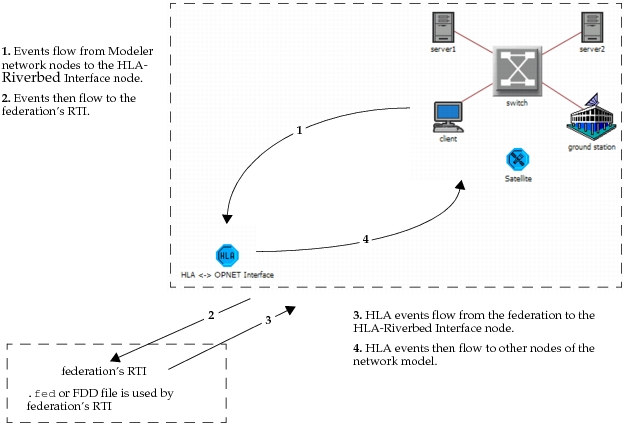
The following figure shows the topology of an example Riverbed federate and illustrates how events flow between the Riverbed federate and the federation.
Figure 1: Example Riverbed Federate
The simulation can be static (using op_mksim) or dynamic (using op_runsim).
A Riverbed federate is composed of the following elements:
- A network model containing
- Node and link models implementing the simulation behavior, HLA interactions, and HLA outgoing messages.
- A special HLA interface node model (called
HLA<->Riverbed Interfacein Figure 1). This node is the interface between the federation’s representation of the global simulation and Modeler’s representation of its local components. It contains a factory function responsible for creating the model’s Federate Ambassador.
- An SOM (Simulation Object Model) file specifying the HLA interface of the federate.
- The
.fedor FDD file, shared by all federates. This file is based on a comprehensive list of the SOMs of all federates. It lists all object classes, attributes, interactions, and parameters any federate in the federation can generate, receive, or handle. This file does not include type information.
HLA Interface Node
The HLA interface node contains the HLA process model (the HLA-PM). This process model serves only as a bridge between the HLA RTI (Run-Time Infrastructure) and the Modeler components responsible for the simulation itself. Thus, it is not responsible for
- Generating the federation’s FOM file, or the related
.fedfile (RTI 1.3) or.xmlFDD file (RTI 1516). You must prepare these files yourself. - Creating the Modeler network model and the process models that implement the federate’s actions and SOM-specified behavior. You must create these models yourself.