Implementation Details
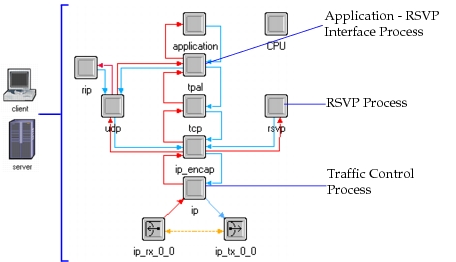
The actual RSVP implementation is achieved through the cooperation of three processes: the RSVP—application interface process, the RSVP process, and the traffic control process. The same is true for the Riverbed Modeler implementation.
-
RSVP—Application Interface Process: This is the interface process between the application process and the RSVP process. This corresponds to the RSVP APIs for the UNIX (RAPI) and Windows (GQoS) environment.
This process is invoked when the Application starts a new TCP/UDP session and RSVP is enabled for the application. The RSVP—application interface process sends a request to the local RSVP process to begin processing a new session. It also makes a reservation decision and sends a resource reservation request to the local RSVP process.
In Riverbed Modeler, this process is in the Transport Protocol Adaptation Layer (TPAL).
Figure 469: Processes Involved in RSVP’s Implementation
The following table lists the defined process models used to represent the above mentioned processes.
Table 191: RSVP Process Models
| Process Model | Layer | Description |
|---|---|---|
rsvp |
RSVP | The core RSVP process modeling the RSVP process. |
tpal_intf_rsvp |
TPAL | This process is a child process of both tpal_intf_tcp_v3 and tpal_intf_udp_v3 process models. The tpal_intf_rsvp, tpal_intf_tcp_v3, and tpal_intf_udp_v3 process models represent the RSVP - application interface process. |
ip_output_iface |
IP | Represents the traffic control process. It is a child process of ip_rte_v4 process model, and there is one ip_output_iface process model per one active interface. |
-
RSVP Process: This is the core RSVP process. This process handles requests from the local Application’s RSVP interface process to start or to end RSVP processing for a particular session. The RSVP Process also processes RSVP messages and creates and deletes RSVP states. Finally, the RSVP process sends requests to the traffic control process to make resource reservations for a particular data flow.
Note that the RSVP process is not in the data path. The RSVP process sends RSVP packets to the ip_encap process, which encapsulates them into IP datagrams. This process communicates with the Application—RSVP Interface process and the Traffic Control process using requests (remote interrupts in Riverbed Modeler).
-
Traffic Control Process: While the RSVP—application interface process decides if a reservation should be requested, and the RSVP process builds and sends reservation messages, it is the traffic control process that actually makes the resource reservation.
The traffic control process consists of the packet classifier, the packet scheduler, and the admission control. The packet classifier determines the QoS class for each packet by placing the packet in the appropriate queue. The packet scheduler obtains the promised QoS for each outgoing interface. The admission control process determines if there are enough resources to grant the reservation.
There are two types of service specifications defined for Integrated Service and RSVP: Controlled Load and Guaranteed Quality of Service.
- Controlled Load simulates a best-effort Quality of Service that is not affected by excessive load. To achieve this, the controlled load service reserves a specific amount of bandwidth for applications that requested the service. This bandwidth is always available to a requesting application irrespective of other traffic. When all devices devote the same bandwidth to the application, the result is a bandwidth pipe that acts like a best-effort network. Controlled load service does provides no guarantees for the end-to-end delay experienced by a particular packet.
- Guaranteed Quality of Service provides for bandwidth and a deterministic upper bound on packet delay.
The RSVP model supports Controlled load service. This service is supported for Weighted Fair Queuing (WFQ) and Custom Queuing schemes. In the Riverbed Modeler implementation, WFQ and Custom Queuing create or delete a queue with requested parameters (bandwidth and buffer size) when needed. Therefore, there is one queue per reservation and the number of queues is dynamic and depends on the number of reservations in place on a node.