Process Parameters
This compound attribute configures IS-IS parameters on a per-process basis. The configurable attributes that affect simulation results are described below.
Figure 303: Process Parameters for IS-IS
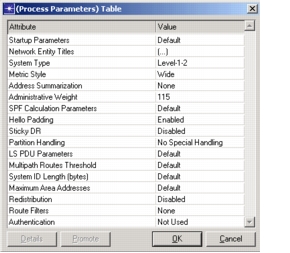
- IP Routing Protocol > IS-IS Parameters > Processes > Process Parameters > Startup Parameters > Start Time. Specifies when IS-IS processing begins on the node.
- Network Entity Titles. Specifies one or more identifiers of the router. Each router must have at least one network entity title specified. A router may have multiple NETs, but each NET must be unique within the network. A NET specifies the router’s Area ID, System ID, and N-Selector (N-Sel). When specifying multiple NETs for a router, only the Area ID can vary—the system ID must be the same for each NET on the router and the N-Selector must be 00 for all routers.
Figure 304: Specifying a Router’s Network Entity Titles Attribute
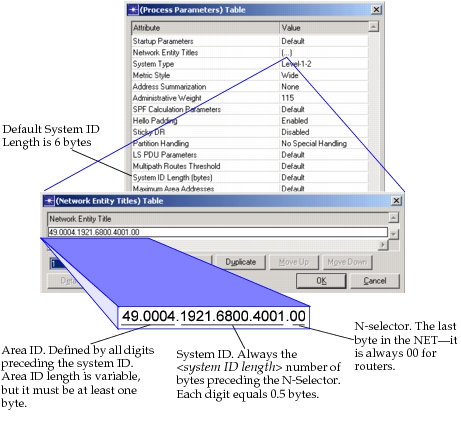
When reading a NET, the model ignores any dots and considers only hexadecimal digits—other characters are invalid. Therefore, it is very important to specify the NET as illustrated in Figure 304.
- System Type. Specifies on which levels the router operates. A router can operate on Level-1, Level-2, or Level-1-2 (both).
Table 129: System Type Options
| This System Type… | Exchanges routing updates with… |
|---|---|
| Level-1 | Level-1 and Level-1-2 routers in the area |
| Level-2 | Level-2 and Level-1-2 routers in the network |
| Level-1-2 | Level-1 routers in the area — for Level-1 updates Level-2 routers in the network—for Level-2 updates |
- Metric Style. Specifies whether this router supports wide or narrow metrics. The original IS-IS specification allowed a metric value range of 1 to 63, inclusive. Extensions to the protocol (in draft-ietf-isis-traffic-04.txt) permit a wider range of metric values, from 1 to 16777215, inclusive.
- Routing Table Interval. Specifies how often the IS-IS process recalculates routing tables at each level. If no topology changes have occurred since the last routing table calculation, IS-IS does not recalculate the routing tables. Setting a lower value for this attribute allows the routing tables to converge faster but can slow down operations. A higher value allows faster protocol operation, but convergence time increases.
- System ID Length. Specifies the length of the System ID portion of the NET. Each router in the network must use the same value. IS-IS specifications allow this parameter to be configurable, but Cisco routers use a fixed (unconfigurable) system ID length of 6 bytes.
- Maximum Area Addresses. The maximum number of area addresses the node can have. In IS-IS, a router belongs to exactly one area. This is in contrast to OSPF, where a router can belong to multiple areas. The multiple area addresses specified in a router’s NET attribute are simply different aliases of the same area.
- Redistribution. Specifies whether routes learned through other routing protocols are advertised by IS-IS. If set to Disabled, this router advertises only IS-IS routes, whereas the Enabled setting advertises all known routes. Alternatively, you can select Edit... to specify that routes obtained from certain other routing protocols are advertised in IS-IS, while others are not.