Issues with Configuring IP QoS Interface Parameters
Interface Processing Rate
Figure 284: Configuring Interface Processing Rate

The interface processing rate is the speed at which the IP interface services packets (IP datagrams). When configuring this parameter, it is important to consider the lower layer overheads each packet will acquire by the time it gets to the physical layer. (This effect becomes more pronounced for small packets.) Because of this packet size growth, as well as additional traffic originating at the lower layers, the physical layer will experience higher traffic volume than the IP interface. To prevent overflowing the physical layer, the IP interface processing rate should be less than the actual bandwidth of the attached link. The default value used for the IP interface processing rate—75% of the attached link bandwidth—usually serves well for this purpose. In certain cases (especially when dealing with very small packets), the interface speed might need to be reduced even further.
Note: For wireless interfaces, the IP interface speed must be specified in absolute terms (Reserved Bandwidth Type set to Absolute), because there is no link attached to the interface.
Interface Buffer Size
Figure 285: Configuring Interface Buffer Size

The Buffer Size (Bytes) attribute represents the total physical memory available on the interface. This physical limit must be considered when configuring individual queue sizes for a scheduling scheme involving one or multiple queues, because all the queues need to share the common buffer space. The Maximum Queue Size (Pkts) attribute sets the limit in terms of packets (rather than bytes) for each individual queue.
Figure 286: Configuring Maximum Queue Size
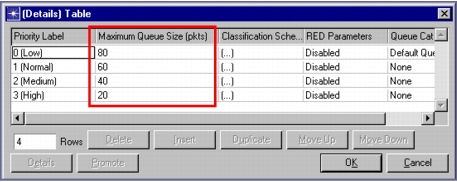
To avoid physical buffer overflow, the configured memory (in bytes) must be large enough to accommodate all of the packets stored in individual queues. In the preceding figure, the maximum total number of packets allowed in all four queues is 200 (80 + 60 + 40 + 20). Based on the interface type and its corresponding MTU, the maximum packet size can be evaluated and the limit in terms of packets can be converted into bytes. If, for example, the interface MTU equals 1,500 bytes, the 200-packet limit translates into 300 Kbytes. The value configured in Buffer Size (Bytes), therefore, should be larger than 300 Kbytes (the default value for this attribute is 1 Mbytes).