Mainframe Configuration Object Attributes
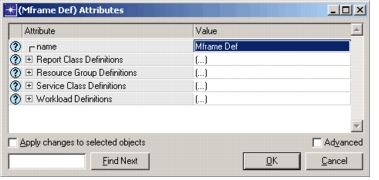
The Mainframe Configuration object has several attributes describing the underlying mainframe hardware, service classes, report classes, and workloads. Attributes described in the Mainframe Configuration object are listed below:
Figure 348: Mainframe Configuration Object Attributes
-
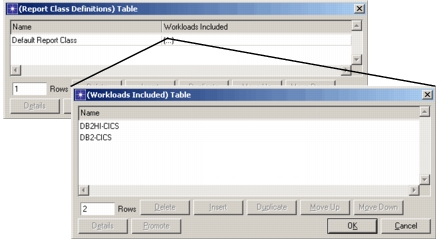
Report Class Definitions. This attribute allows the user to aggregate the results of various workloads as part of a single report class. For example, from the given figure, the Default Report Class has CICS Wkld and DB2 Wkld defined as part of it. These workloads are defined in Workload Definitions attribute.
Figure 349: Report Class Attribute
-
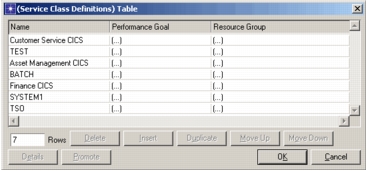
Service Class Definitions. This attribute defines the service policy which can be used by the mainframes if they are running in Goal Mode.
Figure 350: Service Class Attribute
-
Name. Name of the service class.
-
Resource Group. This specifies the minimum and maximum amount of service units that should be allocated to this Service Class.
-
Performance Goal. This specifies the type of the goal and its criteria.
Figure 351: Performance Goal Attribute
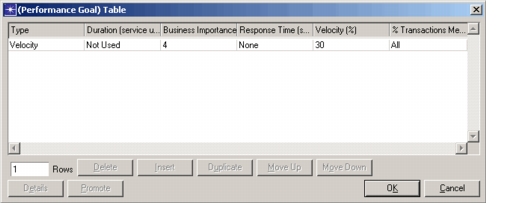
Type. Type of performance goal. It can be Velocity, Response Time or Discretionary.
Response Time. If the goal is of type Response Time, the value is specified here.
Velocity. If the goal is of type Velocity, the value is specified here.
% Transactions Meeting Goal. It specifies the number of transactions that should be meeting this goal.
-
-
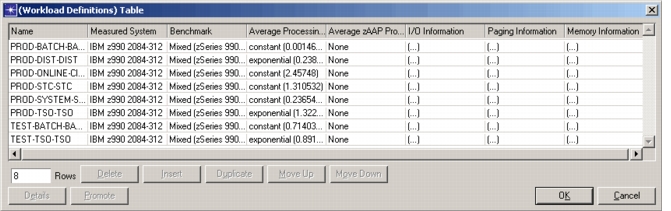
Workload Definitions. This attribute specifies workload descriptions that include information on the measured performance of mainframe jobs. These definitions are independent of the mainframes they run on. The attributes described here apply to the representative instance of the workload.
Figure 352: Workload Definition Attribute
-
Name. A user-defined value which uniquely describes the workload.
-
Measured System. When simulating workloads for systems other than the one on which the measured values were obtained, the model needs to know how to scale these values. This attribute, along with the benchmark, allows scaling to be performed. The mainframe description for this system must already exist before this value can be obtained.
-
Benchmark. As different workloads have different performance characteristics, each workload belonging to a subsystem can be assigned it’s own “benchmark value”. This value is obtained from the list of benchmarks provided for the mainframe described in the “Measured System”. Since this value is used to scale workloads, it must exist in both the measured system described above, and in the target system described on the individual mainframe.
-
Average Processing Time. A distribution describing the amount of processor time consumed by the workload.
-
Average zAAP Processing Time. A distribution describing the average zAAP processing time required by the workload.
-
Paging Information. A set of distribution describing the number of single and shared page faults generated by a single workload instance. This includes both hard (those requiring an I/O operation to exchange data with that on disk) and soft faults (those with data found in memory). This set of distributions is used to specify both Auxiliary and Expanded page faults.
-
I/O Information. Distributions describing the typical I/O behavior of the workload. This includes the number of I/Os and the total I/O response time.
Memory Information. Memory usage is also tracked on a single instance basis. This includes both central and expanded memory.
-